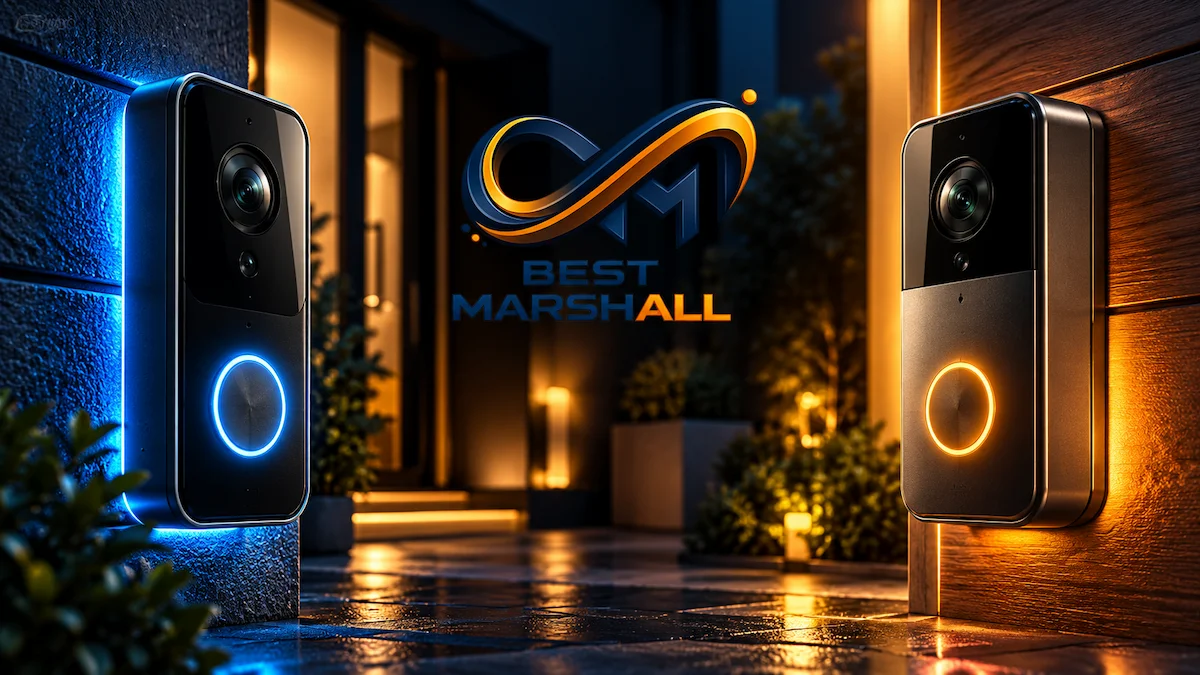
Choosing between the Ring Battery Doorbell 2K and the Blink Battery Doorbell 2K+ is more complicated than comparing resolution numbers.
Both are 2026 battery-powered video doorbells designed for U.S. households. Both record at up to 1920 x 1920 resolution, provide a square head-to-toe view, support two-way communication, work with Alexa, and can be installed without relying on existing doorbell wiring.
The differences start to matter once you look beyond the camera specification.
Ring uses a built-in rechargeable battery, requires no separate hub, provides up to 6x Enhanced Zoom, and fits into Ring’s broader home-security ecosystem. Blink uses replaceable lithium AA batteries, requires a Sync Module, offers subscription-free local recording through compatible Sync Modules, and publishes battery-life estimates that can extend well beyond a year depending on settings.
For this Ring Doorbell vs Blink Doorbell comparison, Best Marshall analyzed official specifications, manufacturer documentation, independent evaluations, current product positioning, subscription structures, and recurring patterns in publicly available customer feedback. Best Marshall did not physically test or use either product.
Let’s compare the two directly and determine which one better fits different types of buyers.
Ring Battery Doorbell 2K vs Blink Battery Doorbell 2K+: Quick Comparison
| Feature | Ring Battery Doorbell 2K | Blink Battery Doorbell 2K+ |
|---|---|---|
| Video resolution | 1920 x 1920 | 1920 x 1920 |
| Aspect ratio | 1:1 Head-to-Toe | 1:1 Head-to-Toe |
| Field of view | 140° horizontal x 140° vertical | 140° horizontal x 140° vertical |
| Zoom | Up to 6x Enhanced Zoom | No comparable enhanced zoom feature emphasized |
| Night vision | Infrared Night Vision | Infrared Night Vision |
| Two-way audio | Yes | Yes, with noise suppression |
| Battery | Built-in rechargeable lithium-ion | Three replaceable AA lithium batteries |
| Published battery estimate | No fixed universal runtime | Up to 16–22 months depending on video mode and usage |
| Optional wiring | Yes, with battery trickle charging | Yes, but batteries are still required |
| Hub required | No | Yes, Sync Module required |
| Local storage without subscription | No | Yes, with compatible Sync Module and storage media |
| Cloud recording | Subscription required | Subscription required |
| Video history | Up to 180 days with compatible Ring plan | Up to 60 days with compatible Blink plan |
| Wi-Fi | 2.4GHz Wi-Fi 4 | 2.4GHz Wi-Fi |
| Weather rating | Weather resistant; current specification lists IPX | IP65 |
| Alexa integration | Yes | Yes |
| Dimensions | 5.78 x 2.11 x 1.41 in | 5.19 x 1.89 x 1.34 in |
| Best fit | Ring ecosystem and simpler hub-free setup | Long battery life and local-storage flexibility |
Quick Recommendation
Choose the Ring Battery Doorbell 2K if you prioritize:
- a hub-free installation;
- rechargeable power;
- optional trickle charging;
- 6x Enhanced Zoom;
- the Ring ecosystem;
- longer cloud video-history capability.
Choose the Blink Battery Doorbell 2K+ if you prioritize:
- long intervals between battery replacements;
- subscription-free local video storage;
- replaceable rather than rechargeable batteries;
- a clearly specified IP65 weather rating;
- the Blink ecosystem;
- stronger value when you already own a compatible Sync Module.
Neither is automatically better for everyone. The most important difference is arguably not image resolution at all—it is how each system handles power, storage, subscriptions, and ecosystem requirements.
Design and Build Quality
At first glance, Ring and Blink use the same basic design philosophy: tall, narrow devices intended to mount beside a front door without dominating the entrance.
The Blink Battery Doorbell 2K+ is the more compact of the two.
Blink specifies dimensions of approximately:
- 5.19 inches tall;
- 1.89 inches wide;
- 1.34 inches deep.
It weighs approximately 4 ounces.
The Ring Battery Doorbell 2K measures approximately:
- 5.78 inches tall;
- 2.11 inches wide;
- 1.41 inches deep.
That makes Blink somewhat shorter, narrower, and thinner.
The practical difference is modest, but Blink may fit more easily on narrow doorframes or locations where mounting space is limited.
Ring offers its current model in several finishes, including Speckled Gray, Speckled White, and Matte Mocha, giving buyers somewhat more flexibility to match the doorbell to an exterior.
Weather Resistance
Blink has the clearer specification here.
The Battery Doorbell 2K+ carries an IP65 weather-resistance rating and is specified for operating temperatures from approximately -5°F to 113°F.
Ring lists the Battery Doorbell 2K as weather resistant and specifies an operating range from approximately -5°F to 120°F. However, Ring’s current technical page describes the ingress rating only as IPX, without publishing a complete numerical IP designation for this model.
That does not mean Ring is unsuitable for normal outdoor installation. It does mean Blink provides the more specific published ingress-protection rating.
For buyers in exposed locations where a formal IP specification matters, that is a meaningful advantage for Blink.
Video Quality: Ring Doorbell vs Blink Doorbell
This is one area where the two products are remarkably similar on paper.
Both record at:
1920 x 1920 pixels
and both provide approximately:
140° horizontal x 140° vertical coverage.
The square 1:1 image is designed specifically for doorbell use.
Traditional widescreen security cameras often capture large areas to the left and right while cutting off the ground directly beneath the camera. A taller head-to-toe image is better suited to showing both a visitor’s face and a package left near the threshold.
Ring’s Advantage: Enhanced Zoom
Ring supplements its 2K image with up to 6x Enhanced Zoom.
Digital zoom cannot create detail that the camera never captured, so it should not be confused with an optical telephoto lens. However, starting from a 1920 x 1920 image gives Ring more information to work with than older lower-resolution models.
For users who frequently inspect details within recorded or live footage, Ring’s enhanced zoom capability is a useful differentiator.
Blink’s Advantage: Adjustable Video Quality
Blink provides three selectable recording-quality levels:
- Best: 1920 x 1920 at approximately 24 fps;
- Standard: 1440 x 1440 at approximately 24 fps;
- Saver: 960 x 960 at approximately 15 fps.
This gives users direct control over the trade-off between image quality and battery longevity.
Blink also uses Local Tone Mapping to improve visibility across bright and dark regions of an image.
That flexibility is especially useful for battery-conscious buyers who do not necessarily need maximum resolution for every recording.
Video Quality Verdict
For maximum specification quality, this category is close because both cameras provide true 1920 x 1920 head-to-toe video.
Ring has the stronger feature if zooming into detail matters.
Blink has the more flexible approach if balancing resolution against battery life matters.
Night Vision
Both cameras use infrared technology for nighttime viewing.
Ring states that the Battery Doorbell 2K provides infrared night vision and enhanced low-light processing, with illumination reaching approximately 20 feet under its published conditions.
Blink specifies infrared night vision with illumination reaching as far as approximately 33 feet when configured for maximum IR intensity.
Blink also allows users to adjust infrared intensity between:
- Low;
- Medium;
- High.
Using higher infrared intensity can increase visibility but also increase power consumption during battery operation.
The published illumination distances should not be treated as direct measurements of overall night-image quality. Camera processing, ambient light, mounting location, reflective surfaces, and subject distance can all influence what the camera actually captures.
Still, Blink provides more direct control over infrared intensity and publishes a longer maximum illumination range.
Motion Detection and Smart Alerts
Both doorbells provide motion notifications without requiring a paid subscription.
That means either system can alert your phone when movement occurs and allow you to open Live View.
The differences become more significant when advanced recognition and recorded events are considered.
Ring
The Ring Battery Doorbell 2K supports:
- Motion Detection;
- customizable motion zones;
- adjustable motion sensitivity;
- real-time notifications;
- Live View;
- Two-Way Talk.
Compatible Ring subscriptions add more advanced features, including smart detection and recorded video-history functionality.
Package Alerts are among the subscription-dependent features available for compatible Ring doorbells.
Ring’s broader software ecosystem also includes increasingly advanced notification tools across its subscription tiers.
Blink
Blink provides:
- motion-triggered notifications;
- Live View;
- customizable recording settings;
- PIR-based motion detection;
- person and vehicle detection with compatible subscription plans.
Its newer AI subscription tiers can also provide Blink Video Descriptions, which summarize what occurred in a motion event.
For example, rather than receiving only a generic motion alert, the system can provide a text description explaining what was detected.
Which Is Better?
Ring has the advantage for buyers who want to build a broader security ecosystem and prioritize Ring’s mature notification and camera infrastructure.
Blink has become considerably more sophisticated in 2026, particularly through Video Descriptions, but many of its advanced capabilities also depend on a subscription.
For basic motion alerts, neither requires one.
Audio and Two-Way Communication
Both products allow users to speak with someone at the door through their smartphones.
Ring provides Two-Way Talk through the Ring app.
Blink also provides two-way audio but adds manufacturer-specified noise suppression.
That may help improve conversation intelligibility in environments affected by road noise, wind, or other ambient sound.
However, microphone and speaker performance can vary considerably depending on installation location and network conditions.
Neither should be treated as a replacement for a dedicated intercom system.
On specifications alone, Blink has the more explicit audio-processing feature set.
Battery Life and Power: One of the Biggest Differences
The Ring Doorbell vs Blink Doorbell power comparison reveals two fundamentally different approaches.
Ring: Rechargeable Internal Battery
Ring uses a built-in lithium-ion rechargeable battery.
When the battery needs a full recharge, the complete doorbell must be detached from its mounting bracket and charged.
That creates temporary downtime unless the device is receiving supplemental power through compatible wiring or solar charging.
Ring does not publish a single universal battery-life estimate for this model because runtime varies significantly with:
- motion frequency;
- Live View usage;
- temperature;
- Wi-Fi quality;
- recording activity;
- device settings.
The major advantage is that the battery does not need to be replaced with disposable cells.
Blink: Three Replaceable Lithium AA Batteries
Blink uses three non-rechargeable Energizer AA lithium batteries.
According to Blink’s current estimates:
- Best-quality 1920 x 1920 mode can provide up to approximately 16 months;
- Standard mode can reach approximately 19 months;
- Saver mode can reach approximately 22 months.
Actual battery life will depend on usage, temperature, clip frequency, infrared intensity, and other settings.
The advantage is obvious: battery maintenance can potentially be much less frequent than recharging a typical rechargeable doorbell.
And when the batteries eventually run out, users simply replace them rather than removing the doorbell for a charging session.
The disadvantage is the ongoing cost and waste associated with disposable lithium batteries.
Wiring Changes the Equation
Ring can connect to compatible 8–24 VAC doorbell wiring for trickle charging.
That can significantly reduce how often the internal battery needs to be manually recharged.
Blink can also connect to existing wiring, but the Battery Doorbell 2K+ still requires its AA batteries.
Wiring can support compatible in-home chime functionality and provides additional operational benefits, but it does not eliminate the battery requirement.
Battery Verdict
Blink has the advantage for maximum battery longevity.
Ring has the advantage for rechargeable ownership and optional trickle charging.
The better system depends on whether you prefer occasionally recharging a built-in battery or replacing lithium AA cells much less frequently.
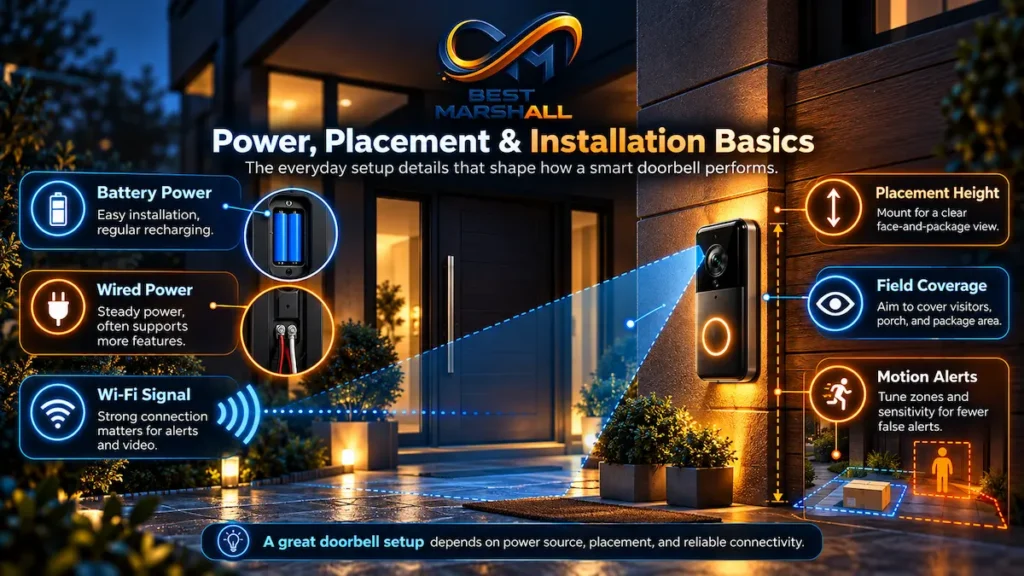
Installation: Ring Is Simpler From a System Perspective
Both products are designed for DIY installation.
Ring estimates that installation can take around 10 minutes under suitable conditions.
Blink is also designed for relatively straightforward mounting and can operate without doorbell wiring.
However, there is one important difference:
Blink Battery Doorbell 2K+ requires a compatible Blink Sync Module to operate.
Ring does not require an equivalent hub.
This means a first-time Blink buyer needs to make sure the selected product configuration includes a compatible Sync Module or obtain one separately.
Existing Blink users who already have a compatible module do not face the same issue.
This distinction also affects value.
Blink’s doorbell hardware can appear less expensive in isolation, but a first-time buyer needs to consider the required Sync Module as part of the system cost.
Ring connects directly to the home’s Wi-Fi network and the Ring app.
Installation Verdict
For someone starting from zero, Ring has the simpler system requirement.
For someone who already owns a Blink Sync Module, that advantage largely disappears.
Wi-Fi and Network Requirements
Both products rely on 2.4GHz Wi-Fi.
Neither provides dual-band 5GHz connectivity.
Ring recommends at least 10 Mbps upload bandwidth for its 2K devices and warns that delivered resolution can vary with network bandwidth.
Blink publishes a minimum upload requirement of approximately 2 Mbps.
The lower published requirement does not guarantee that Blink will perform better on a weak or congested network. Wi-Fi signal strength, interference, router placement, walls, and network traffic can all affect doorbell responsiveness.
Public customer feedback for both ecosystems includes occasional reports of slow loading or connectivity problems, reinforcing the importance of strong Wi-Fi coverage at the front door.
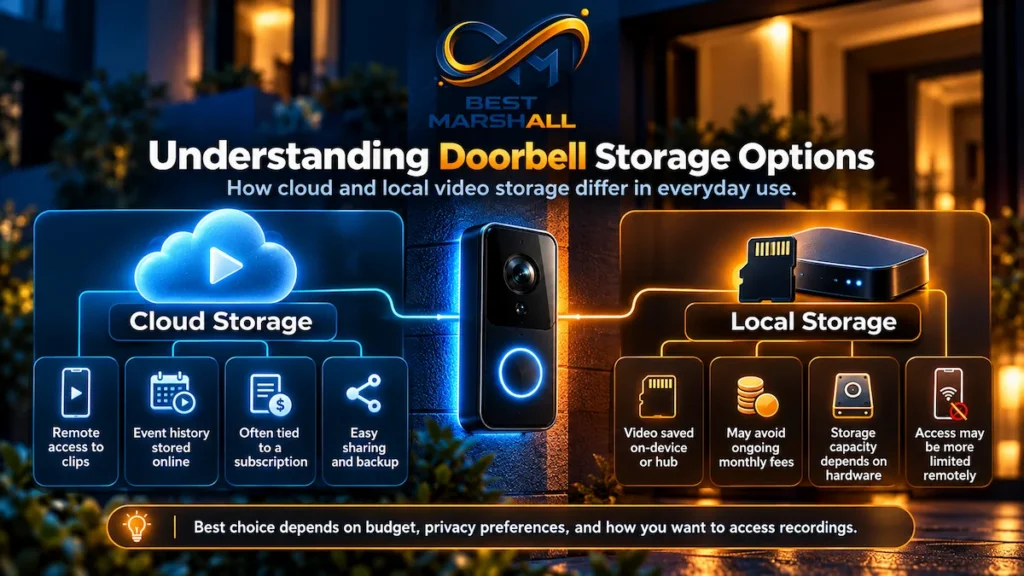
The Biggest Blink Advantage: Local Storage Without a Subscription
For subscription-conscious buyers, this may be the most important difference in the entire comparison.
The Blink Battery Doorbell 2K+ supports local video storage without a paid subscription when paired with compatible hardware.
Depending on the Sync Module, storage can use:
- a USB drive;
- or a microSD card.
That means Blink users can retain recorded motion clips locally without paying continuously for cloud storage.
Ring does not provide an equivalent local-storage option for the Battery Doorbell 2K.
Without a compatible Ring subscription, Ring users can still access:
- Live View;
- Two-Way Talk;
- real-time motion notifications.
But missed events are not stored for later review.
For a security camera, that is a substantial distinction.
If something happens while you are sleeping, working, driving, or away from your phone, the ability to review the event afterward can be one of the main reasons to own a video doorbell.
Storage Verdict
For buyers who actively want to avoid recurring cloud-storage fees, Blink has the clear advantage.
Cloud Storage and Subscription Features
Both ecosystems become more capable when paired with subscriptions.
Ring provides up to 180 days of cloud video history with compatible plans.
Blink provides up to 60 days of cloud storage with compatible subscription plans.
Advanced detection features also depend on subscriptions in both ecosystems.
Ring Subscription Benefits
Depending on the compatible plan and device, Ring can provide features such as:
- recorded event history;
- person and package alerts;
- video descriptions;
- enhanced notification features;
- longer ecosystem-level security capabilities.
Blink Subscription Benefits
Blink plans can provide:
- cloud recording;
- up to 60 days of cloud storage;
- person and vehicle detection;
- Live View recording;
- additional smart features.
Blink’s AI tiers add Video Descriptions and other AI-focused functionality.
Which Subscription Ecosystem Is Better?
Ring provides the longer maximum cloud-history period and a broader security ecosystem.
Blink’s main advantage is that users who do not want cloud storage can choose local recording instead.
That makes the subscription decision structurally different:
Ring’s subscription is much more important if you want recorded history.
With Blink, local storage gives buyers another path.
Alexa and Smart-Home Ecosystem
Both Ring and Blink integrate with compatible Alexa devices.
Depending on the setup, users can receive doorbell announcements and access camera functions through compatible Echo devices.
The difference is ecosystem depth.
Ring has developed a broad home-security platform that includes:
- multiple doorbells;
- indoor and outdoor cameras;
- security systems;
- lighting and accessories;
- centralized Ring app management.
For someone already using Ring cameras or Ring Alarm, adding a Ring Battery Doorbell 2K keeps everything within one established system.
Blink also offers multiple cameras and integrates closely with Alexa, but its ecosystem is positioned more heavily around accessible, battery-efficient cameras and simpler home monitoring.
Ecosystem Verdict
Existing ecosystem ownership should strongly influence this decision.
If you already own several Ring products, there is little reason to switch ecosystems solely because Blink wins one or two specification categories.
The reverse is also true for an established Blink household.
What Customer Feedback Suggests
Publicly available customer feedback for both products is generally positive, but the recurring themes differ somewhat.
Ring Battery Doorbell 2K Feedback
Users frequently highlight:
- improved 2K image clarity;
- head-to-toe framing;
- straightforward installation;
- integration with existing Ring products.
Recurring concerns include:
- subscription dependence for recorded video;
- occasional loading or connectivity delays;
- the need to remove the entire device for full battery charging.
These complaints do not affect every installation, and network conditions can substantially influence responsiveness.
Blink Battery Doorbell 2K+ Feedback
Users commonly praise:
- clear 2K video;
- easy installation;
- compact dimensions;
- long battery expectations;
- motion notifications;
- straightforward Alexa integration.
Some customer reports mention:
- occasional lag or connectivity issues;
- frustration with subscription-dependent cloud features;
- the requirement for a Sync Module;
- additional chime considerations in fully wireless installations.
Because the Blink Battery Doorbell 2K+ is relatively new, long-term reliability evidence is still developing.
Neither product has enough real-world history in its current 2026 generation to justify strong conclusions about many years of durability.
Ring Battery Doorbell 2K Pros and Cons
Pros
- 1920 x 1920 head-to-toe video
- Up to 6x Enhanced Zoom
- No separate hub required
- Rechargeable battery
- Optional wiring provides trickle charging
- Strong integration with the wider Ring ecosystem
- Up to 180 days of cloud video history with compatible plan
- Multiple exterior color options
Cons
- No subscription-free local recording
- Entire doorbell must be removed for full battery charging
- Recorded video history requires a compatible subscription
- 2.4GHz-only Wi-Fi
Blink Battery Doorbell 2K+ Pros and Cons
Pros
- 1920 x 1920 head-to-toe video
- Long manufacturer-rated battery life
- Replaceable AA batteries minimize charging downtime
- Local storage available without subscription
- IP65 weather-resistance rating
- Adjustable video-quality modes
- Enhanced audio with noise suppression
- Strong value for existing Blink households
Cons
- Requires a compatible Sync Module
- Uses disposable lithium AA batteries
- Advanced cloud and smart features require subscription plans
- 2.4GHz-only Wi-Fi
Value for Money: Ring Doorbell vs Blink Doorbell
Price alone does not determine which doorbell offers better value.
At the time of research, the Ring Battery Doorbell 2K generally occupied a higher upfront hardware tier than Blink’s Battery Doorbell 2K+ add-on configuration.
That comparison needs context.
Blink May Cost Less—But Requires a Sync Module
If you already own a compatible Blink Sync Module, the Battery Doorbell 2K+ can represent particularly strong value.
You receive:
- 2K video;
- head-to-toe coverage;
- very long rated battery life;
- two-way audio;
- local-storage capability;
- Alexa integration.
For a new Blink customer, however, the required Sync Module needs to be included in the ownership calculation.
A lower doorbell price does not necessarily mean a lower complete-system price.
Ring Costs More but Requires No Hub
Ring operates without an additional Sync Module.
Its higher hardware positioning also includes:
- 6x Enhanced Zoom;
- rechargeable power;
- trickle-charging capability;
- Ring ecosystem integration;
- longer cloud-history potential.
For someone who already owns Ring devices, those advantages can easily outweigh a modest hardware-price difference.
Long-Term Cost Favors Different Buyers
Blink can potentially reduce recurring cloud costs through local storage.
Ring avoids disposable battery purchases but places greater emphasis on subscription-based recording.
That creates two very different value propositions.
Blink may offer stronger long-term value for buyers who want local storage and minimal subscription dependence.
Ring may offer stronger value for buyers who prioritize software integration, rechargeable power, and the broader Ring security ecosystem.
Final Verdict: Which One Should You Buy?
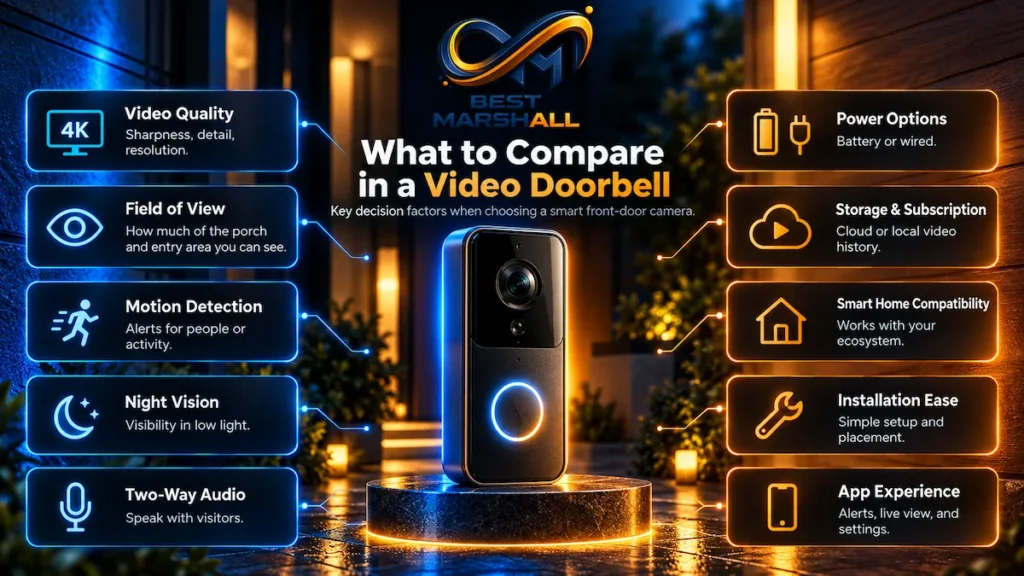
The Ring Doorbell vs Blink Doorbell decision is not really about which device has the higher resolution—because both provide essentially the same 1920 x 1920 head-to-toe format.
The meaningful differences are power management, storage, subscriptions, system requirements, and ecosystem.
Choose the Ring Battery Doorbell 2K If:
- you already use Ring cameras or Ring Alarm;
- you want a doorbell that does not require a separate hub;
- you prefer rechargeable batteries over disposable lithium cells;
- you can use existing wiring for trickle charging;
- 6x Enhanced Zoom is useful to you;
- you prefer Ring’s broader security ecosystem;
- longer cloud video history matters.
Choose the Blink Battery Doorbell 2K+ If:
- you already own a compatible Blink Sync Module;
- you want local recording without a cloud subscription;
- long battery life is a major priority;
- you prefer quickly replacing AA batteries instead of recharging a doorbell;
- an explicit IP65 weather rating matters;
- you want adjustable video quality to balance battery life and image detail;
- minimizing long-term subscription dependence is important.
Best Marshall’s Conclusion
For ecosystem integration and simplicity, the Ring Battery Doorbell 2K is the stronger fit. It requires no separate hub, works naturally within Ring’s mature security platform, and provides rechargeable power with optional trickle charging.
For battery longevity and storage flexibility, the Blink Battery Doorbell 2K+ has the more compelling proposition. Its ability to store recordings locally without an ongoing subscription is especially important for buyers who dislike recurring cloud fees.
For a completely new buyer with no existing smart-security ecosystem, the decision comes down to one central question:
Would you rather have Ring’s simpler hub-free ecosystem, or Blink’s local-storage and long-battery-life advantages?
That answer matters more than the nearly identical 2K resolution specifications.
Ultimately, the better choice depends on which strengths matter most for your home, security priorities, and long-term budget.
Check Current Price and Availability on Amazon
Ring Battery Doorbell 2K
Check Current Price on Amazon
Blink Battery Doorbell 2K+
Check Current Price on Amazon
Pricing, bundle contents, seller availability, and included accessories can change. For the Blink model in particular, verify whether the Amazon listing includes a compatible Sync Module or is sold as an add-on device before making your decision.