
Choosing between a dynamic microphone and a condenser microphone is one of the first technical decisions most streamers, podcasters, musicians, voice actors, and content creators face.
The common advice sounds simple: use a dynamic microphone in a noisy room and a condenser microphone in a studio.
There is some practical truth behind that recommendation, but it leaves out most of what actually determines microphone performance.
Dynamic and condenser describe how a microphone converts acoustic energy into an electrical signal. That transducer design affects sensitivity, output level, electrical requirements, transient response, self-noise, maximum sound-pressure handling, durability, and how the microphone interacts with the rest of the recording chain.
It does not, by itself, determine polar pattern, frequency response, sound quality, or how much background noise will appear in a recording.
A cardioid dynamic microphone placed 3 inches from a speaker can produce a very different direct-to-room balance from a cardioid condenser sitting 18 inches away. But that difference involves placement and gain structure as much as microphone technology.
If you are choosing among USB models, our guide on how to choose a USB microphone explains how microphone type, polar pattern, connectivity, monitoring, room conditions, and other factors should work together.
This guide explains how both designs actually work, where their technical differences matter, which specifications should influence a purchase, and how to choose the right microphone for podcasting, streaming, vocals, instruments, gaming, and home recording.
Quick Answer: Dynamic vs Condenser Microphone — What’s the Difference?
A dynamic microphone typically uses a diaphragm, voice coil, and magnet to generate an electrical signal directly from sound, while a condenser microphone uses a lightweight electrically charged diaphragm and backplate plus active electronics. Dynamic microphones usually have lower sensitivity, require more preamp gain, tolerate demanding environments well, and work especially well for close-mic speech and loud sources. Condenser microphones usually provide higher sensitivity, lower required preamp gain, wider high-frequency extension, and greater detail, but they require electrical power.
The basic comparison looks like this:
| Characteristic | Dynamic Microphone | Condenser Microphone |
|---|---|---|
| Transducer principle | Moving coil and magnet in most common dynamics | Electrically charged diaphragm and backplate |
| Sensitivity | Usually lower | Usually higher |
| Preamp gain required | Usually more | Usually less |
| External power | Usually not required | Required in some form |
| Phantom power | Usually unnecessary | Common with professional XLR models |
| Self-noise specification | Usually not applicable to passive capsule itself | Important specification |
| High SPL handling | Typically excellent | Can also be excellent; check specification |
| Transient detail | Traditionally lower | Traditionally higher |
| High-frequency extension | Often more limited or shaped | Often broader or more extended |
| Physical durability | Usually excellent | Varies by design |
| Close speech | Excellent | Excellent with proper setup |
| Untreated room | Often easier to manage close-up | Can work well, but placement becomes critical |
| Detailed studio recording | Capable | Often preferred |
| Typical live vocals | Very common | Also available |
| Interface gain demand | Can be significant | Usually lower |
Neither technology is inherently “better.”
The correct choice depends on what you are recording, where you are recording it, how close the microphone will be to the source, and what equipment sits between the microphone and the recording software.
What Is a Dynamic Microphone?
The most common dynamic microphone used for vocals, podcasting, streaming, and live sound is technically a moving-coil dynamic microphone.
Inside the capsule is:
- a diaphragm;
- a small coil of conductive wire;
- a magnetic structure.
Sound pressure moves the diaphragm.
Because the coil is physically attached to the diaphragm, it moves inside the magnetic field.
That movement generates an electrical voltage.
The microphone therefore acts as a small acoustic generator.
No active amplification is required inside a conventional passive moving-coil dynamic capsule.
This relatively simple mechanical system is one reason dynamic microphones are widely used in:
- live vocals;
- guitar amplifiers;
- drums;
- broadcast speech;
- podcasting;
- streaming;
- touring applications.
What Is a Condenser Microphone?
A condenser microphone uses a different transduction principle.
Its capsule contains:
- a thin conductive diaphragm;
- a fixed backplate;
- a small gap between them.
Together, these elements form a capacitor.
As sound pressure moves the diaphragm, the distance between the diaphragm and backplate changes.
That alters the electrical capacitance.
The resulting electrical variation represents the incoming sound.
Unlike a conventional passive moving-coil microphone, a condenser microphone also requires active electronics to make that signal usable.
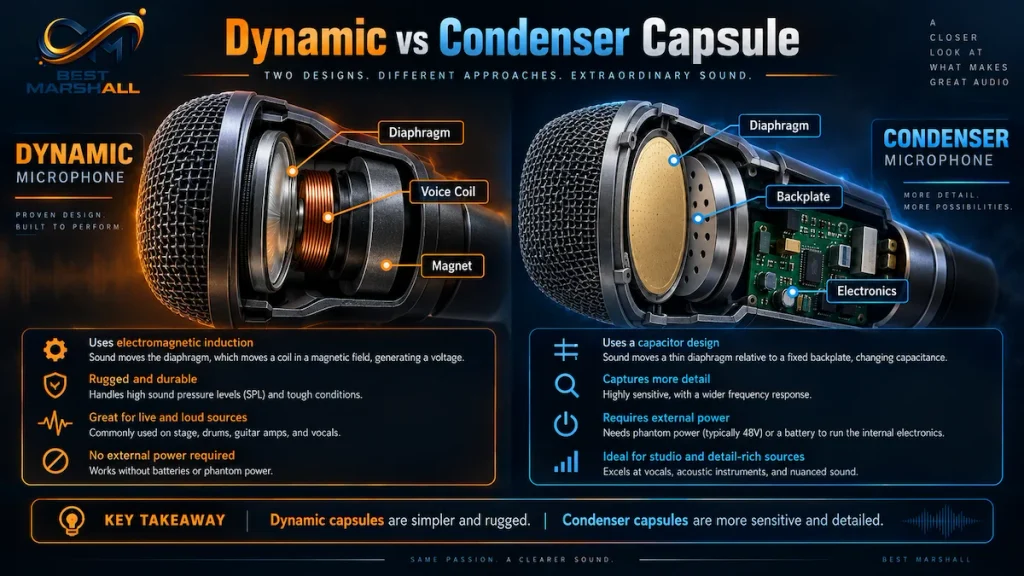
That means condenser microphones need electrical power.
Depending on the design, that power may come from:
- 48V phantom power;
- another phantom-power voltage;
- a battery;
- plug-in power;
- an external dedicated power supply;
- USB power.
So the statement “condenser microphones require phantom power” is useful but incomplete.
Professional XLR studio condensers commonly use phantom power, but not every condenser receives power in exactly the same way.
What Is Phantom Power?
Phantom power is DC voltage supplied through a balanced microphone cable while the same cable carries the audio signal.
In professional audio equipment, 48V phantom power, often labeled:
+48V
is extremely common.
The microphone input on an audio interface, mixer, preamp, or recorder supplies the voltage through the XLR connection.
This powers the condenser microphone’s internal electronics and, depending on capsule design, may also participate in polarization.
Do Dynamic Microphones Need Phantom Power?
Conventional passive moving-coil dynamic microphones generally do not.
They generate their own output voltage through electromagnetic induction.
Modern balanced dynamic microphones can generally coexist with correctly implemented phantom power without damage because the phantom voltage is applied equally to both balanced signal conductors.
However, this should not become a universal rule for every microphone ever made.
Particular caution is appropriate with:
- certain ribbon microphones;
- damaged cables;
- incorrectly wired equipment;
- unbalanced microphones;
- unusual legacy designs.
Check the manufacturer’s requirements before applying phantom power when the equipment is unfamiliar.
Dynamic vs Condenser: Why Sensitivity Matters
Microphone sensitivity describes how much electrical output a microphone produces for a specified acoustic sound-pressure input.
It is commonly specified in:
- mV/Pa;
- dBV/Pa.
A microphone with higher sensitivity produces a stronger electrical signal from the same acoustic input.
Condenser microphones commonly have higher sensitivity than moving-coil dynamics.
That does not automatically mean they sound better.
It means they produce more electrical output for a given sound pressure.
Why Lower Dynamic-Mic Sensitivity Matters
A low-output dynamic microphone requires more amplification from the microphone preamp.
Some broadcast-style dynamic microphones can require substantial clean gain when recording quiet or normally spoken voices.
For example, Shure’s technical documentation states that the SM7B has low sensitivity and may require more than 60 dB of preamp gain in some setups.
That is a characteristic of that microphone—not a universal requirement for all dynamic microphones—but it demonstrates why preamp capability matters.
If a low-output microphone is paired with an interface that becomes noisy at high gain, the problem may come from the signal chain rather than the microphone capsule.
Does a Condenser Microphone Pick Up More Background Noise?
This is one of the most repeated—and most misunderstood—microphone claims.
The technically accurate answer is:
A condenser microphone does not automatically have a wider “listening radius” simply because it is a condenser.
Background pickup depends heavily on:
- polar pattern;
- microphone position;
- distance to the intended source;
- distance to unwanted sound;
- room acoustics;
- gain structure;
- source volume.
Condensers commonly have higher sensitivity, so they produce a stronger electrical output from quiet sounds at a given acoustic level.
But sensitivity is not the same thing as directionality.
A cardioid condenser does not suddenly become omnidirectional because its capsule is more sensitive.
Why Dynamics Often Seem Better in Noisy Rooms
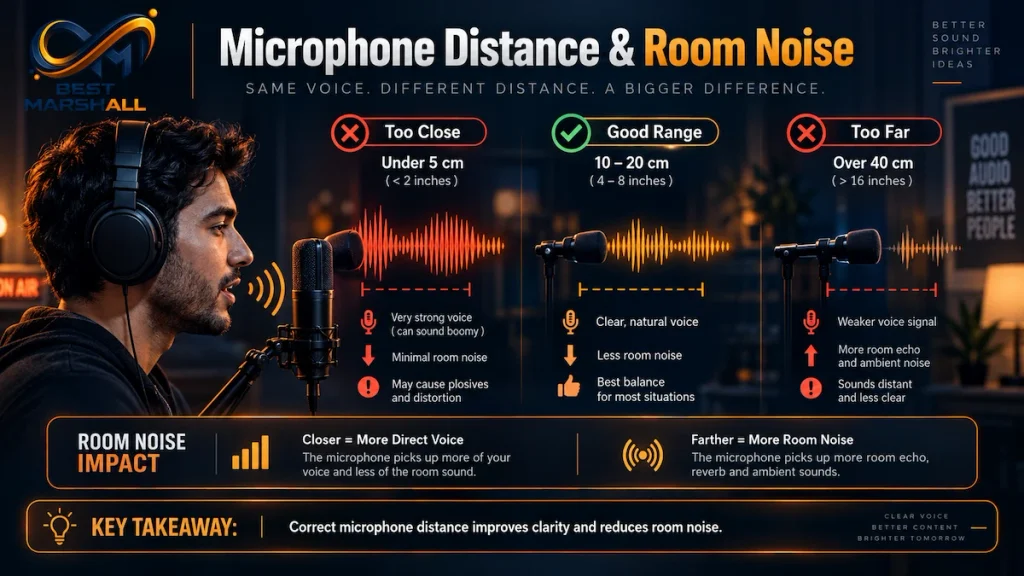
The practical explanation usually involves working distance.
Podcasters and streamers commonly place dynamic microphones very close to the mouth.
The desired voice is therefore much louder at the microphone than:
- the keyboard several feet away;
- the computer fan;
- room reflections;
- outside noise.
This improves the direct-to-ambient ratio.
A condenser placed equally close with the appropriate gain and polar pattern can also produce strong isolation.
But many condenser setups are used farther from the source, where the microphone receives proportionally more room sound.
So the useful buying principle is:
For an untreated room, prioritize close placement and an appropriate directional pattern rather than assuming transducer type alone determines background rejection.
Polar Pattern Is Separate From Microphone Type
Dynamic and condenser describe transducer technology.
Cardioid, supercardioid, omnidirectional, and figure-8 describe directionality.
They are separate characteristics.
A dynamic microphone can be:
- cardioid;
- supercardioid;
- hypercardioid;
- omnidirectional.
A condenser microphone can also use different polar patterns, and some condensers provide electronically switchable patterns.
Cardioid
Most sensitive at the front and less sensitive toward the rear.
Common for:
- streaming;
- podcasting;
- vocals;
- home recording.
Supercardioid and Hypercardioid
Provide narrower frontal pickup but include some rear sensitivity.
These can provide stronger side rejection when positioned correctly.
Omnidirectional
Responds approximately equally in all directions.
Useful when the surrounding acoustic environment is intentionally part of the recording.
Figure-8
Captures from the front and rear while strongly rejecting the sides.
Useful for:
- two-person recording;
- certain stereo techniques;
- advanced studio applications.
When background rejection matters, polar pattern is often more informative than whether the microphone is dynamic or condenser.
Dynamic vs Condenser: Frequency Response
A microphone’s frequency response describes how its output changes across audible frequencies.
Manufacturers commonly specify a range such as:
20Hz–20kHz
but the range alone is not enough.
Two microphones can both list 20Hz–20kHz while sounding completely different because their response curves differ.
A microphone may intentionally emphasize:
- presence frequencies;
- upper mids;
- low mids;
- bass.
Condenser Microphones
Condenser construction makes it comparatively easy to design microphones with:
- extended high-frequency response;
- high sensitivity;
- smooth wide-band response.
This is one reason condensers became dominant in many studio applications.
Dynamic Microphones
Moving-coil dynamics often use more intentionally shaped frequency responses.
A vocal dynamic may emphasize frequencies that improve intelligibility while reducing very low or very high frequencies that are less useful for the intended source.
This can be an advantage rather than a deficiency.
For spoken voice, the goal is not always perfectly flat frequency response.
Transient Response: Why Condensers Often Capture More Detail
A transient is a rapid change in sound level.
Examples include:
- the initial strike of a drum;
- a guitar pick hitting a string;
- consonants in speech;
- piano hammer attack;
- percussion.
The moving assembly in a condenser capsule can be extremely light.
A conventional moving-coil dynamic diaphragm also has to move its attached coil.
That additional moving mass helps explain why condenser microphones have traditionally been associated with faster transient response and greater reproduction of fine high-frequency detail.
This is not an absolute quality ranking.
Modern dynamic microphones can reproduce speech and instruments exceptionally well.
A slower or deliberately shaped response may even be desirable for some sources because it can produce a smoother presentation.
The correct question is:
Does the microphone’s response suit the source?
Does “More Detail” Always Mean Better Sound?
No.
A microphone that captures more high-frequency detail may also reveal more of:
- mouth clicks;
- lip noise;
- keyboard sounds;
- room reflections;
- clothing movement;
- HVAC noise;
- traffic;
- hard-surface reflections.
For a well-treated vocal booth, that sensitivity can be an advantage.
For a streamer sitting beside a mechanical keyboard in a reflective bedroom, it may create additional work.
A microphone should therefore be judged within its environment.
Dynamic vs Condenser: Maximum SPL
Sound Pressure Level, or SPL, describes acoustic pressure and is expressed in decibels.
Very loud sources include:
- snare drums;
- kick drums;
- guitar cabinets;
- brass instruments;
- close-miked percussion.
Dynamic microphones are widely known for handling loud sources well.
That reputation is justified in many applications.
However:
It is incorrect to assume that condenser microphones cannot handle high SPL.
Modern condenser microphones can be engineered for extremely high maximum SPL.
Some include attenuation pads that allow them to accept even louder sources before their internal electronics overload.
When recording loud sources, check the microphone’s actual:
Maximum SPL specification
rather than choosing exclusively by microphone type.
What Is Self-Noise?
Condenser microphones contain active electronics.
Those electronics generate a small amount of electrical noise even when no useful sound is present.
Manufacturers therefore often specify:
Equivalent noise level
or:
self-noise
usually in dBA.
Lower numbers indicate less internally generated noise.
Why Self-Noise Matters
Self-noise is particularly relevant when recording quiet sources such as:
- soft acoustic instruments;
- quiet ambience;
- whispered voice;
- Foley;
- classical music;
- nature sounds.
When recording a loud singer close to the microphone, a small difference in self-noise may be irrelevant because the desired signal sits far above the noise floor.
Passive moving-coil dynamics do not contain the same active internal electronics and therefore are not typically evaluated using an equivalent electronic self-noise specification in the same way.
But the complete recording chain can still contain noise.
Because lower-sensitivity dynamics may require more preamp gain, preamplifier noise becomes more important.
Preamp Gain: A Major Dynamic-Microphone Buying Consideration
An XLR microphone outputs a very small electrical signal.
A microphone preamplifier boosts that signal to a useful level.
Dynamic microphones with low sensitivity can require substantial gain.
Before buying a low-output dynamic microphone, verify the audio interface provides enough clean microphone gain.
Possible symptoms of insufficient gain include:
- recording levels that remain too low;
- gain control operating near maximum;
- noticeable preamp hiss;
- reliance on excessive digital amplification later.
Some users add an inline active preamp or microphone booster between the microphone and interface.
Newer audio interfaces frequently offer enough gain for many low-output dynamics without an additional device, so the external booster should not be treated as universally necessary.
Gain Staging Matters for Both Microphone Types
Proper gain staging means setting input levels so the desired signal is strong enough without clipping.
A common beginner mistake is assuming gain should simply be turned up until the waveform looks large.
Instead:
- position the microphone correctly;
- speak or perform at realistic level;
- increase gain gradually;
- preserve headroom;
- avoid clipping.
RØDE’s current recording guidance, for example, recommends maintaining headroom rather than pushing recording peaks to 0 dBFS.
Digital clipping created during recording is difficult or impossible to repair completely afterward.
Dynamic vs Condenser for Podcasting
For podcasting, both technologies can work extremely well.
Dynamic Microphones Often Make Sense When:
- recording rooms are untreated;
- speakers can remain close to the microphone;
- several microphones share one room;
- computers or HVAC systems generate background noise;
- a broadcast-style sound is preferred.
Condenser Microphones Often Make Sense When:
- the room is quiet or acoustically controlled;
- the microphone needs to capture more natural room detail;
- the creator wants extended high-frequency information;
- one microphone may also record instruments.
The most important variable is still microphone placement.
A poorly positioned expensive dynamic microphone can produce worse recordings than a properly positioned affordable condenser.
Dynamic vs Condenser for Streaming and Gaming
Home streaming environments frequently include:
- keyboard noise;
- mouse clicks;
- computer fans;
- speakers;
- reflective walls.
A close-positioned cardioid dynamic microphone is often easier to manage in this environment because the streamer can maintain a strong voice-to-room ratio.
A condenser can still work well if:
- it is positioned close enough;
- gain is adjusted correctly;
- its null is aimed toward unwanted sound;
- the room is reasonably controlled.
The myth to avoid is:
“Dynamic microphones do not hear keyboards.”
They do.
Any microphone will reproduce sufficiently loud sound entering its pickup pattern.
Dynamic vs Condenser for Voiceover
Professional voiceover environments often favor condenser microphones because detailed vocal reproduction can be beneficial.
A controlled room reduces the amount of unwanted acoustic information reaching the microphone.
That lets the microphone’s:
- sensitivity;
- high-frequency extension;
- low self-noise;
- transient response
become advantages.
However, broadcast-style dynamic microphones are also widely used for narration and voice production.
Voice type, processing, room acoustics, and desired sound all matter.
Dynamic vs Condenser for Singing
There is no rule requiring one technology.
Dynamic Vocal Microphones
Common advantages:
- durability;
- close working distance;
- controlled stage pickup;
- high SPL tolerance;
- reduced sensitivity to environmental handling.
Condenser Vocal Microphones
Common advantages:
- high sensitivity;
- detailed upper frequencies;
- transient reproduction;
- potentially broader frequency response.
Studio vocals are frequently recorded with large-diaphragm condensers, but major professional recordings also use dynamics when their tonal characteristics suit the singer.
Dynamic vs Condenser for Acoustic Guitar
Condenser microphones are especially common for acoustic instruments because they can reproduce:
- string attack;
- harmonics;
- body resonance;
- high-frequency detail.
Small-diaphragm condensers are frequently used when accurate transient and off-axis reproduction are priorities.
Dynamic microphones can still work well when:
- the environment is noisy;
- a more focused tonal character is desired;
- live performance isolation matters.
Again, application matters more than category prestige.
Dynamic vs Condenser for Electric Guitar Amps
Dynamic microphones remain extremely common on guitar cabinets.
Reasons include:
- high SPL tolerance;
- durable construction;
- useful frequency shaping;
- close-miking suitability.
Condenser microphones can also be used on amplifiers, particularly when additional detail or a different tonal perspective is desired.
A condenser’s published maximum SPL should be checked before extremely close use with high-output sources.
Dynamic vs Condenser for Drums
Both types are widely used.
Dynamic microphones commonly appear on:
- snare;
- toms;
- kick drum.
Condenser microphones commonly appear as:
- overheads;
- room microphones;
- hi-hat microphones.
The distinction reflects both acoustic source characteristics and desired tonal capture.
There is no technical rule prohibiting condensers on drums.
Dynamic vs Condenser for Live Performance
Dynamic microphones traditionally dominate many live vocal environments because they combine:
- durability;
- high SPL handling;
- familiar close-miking technique;
- useful directional patterns.
However, professional stage condenser microphones also exist.
Modern condenser construction can be rugged enough for live performance and can provide additional sensitivity or frequency extension.
Therefore:
“Dynamic for live, condenser for studio” is a useful beginner shortcut—not a technical law.
Large-Diaphragm vs Small-Diaphragm Condenser Microphones
Not all condenser microphones behave alike.
Two important categories are:
Large-Diaphragm Condensers
Commonly used for:
- vocals;
- voiceover;
- acoustic instruments;
- general studio recording.
They often provide:
- relatively high sensitivity;
- low self-noise;
- strong vocal presence.
Small-Diaphragm Condensers
Commonly used for:
- acoustic instruments;
- drum overheads;
- stereo recording;
- precise transient capture.
Their smaller capsules can provide excellent high-frequency and off-axis behavior.
Diaphragm size does not create a simple “larger is better” hierarchy.
Proximity Effect Applies to Directional Microphones, Not Just Dynamics
When a directional pressure-gradient microphone is positioned very close to a sound source, bass response can increase.
This is known as the proximity effect.
It is commonly associated with broadcast dynamic microphones because they are frequently used close to the mouth.
But proximity effect is not exclusive to dynamic microphones.
Cardioid condenser microphones can exhibit it as well.
The relevant factor is primarily the directional acoustic design.
Why Proximity Effect Matters
Close placement can make voice sound:
- fuller;
- warmer;
- bassier.
Too much proximity effect can make speech:
- boomy;
- muddy;
- difficult to understand.
Microphone distance therefore functions as a tonal control.
Plosives Affect Both Microphone Types
Plosives are bursts of air produced by consonants such as:
- P;
- B;
- T.
They can cause a sudden low-frequency pressure event at the microphone diaphragm.
Both dynamic and condenser microphones can reproduce plosives.
Possible solutions include:
- pop filters;
- foam windscreens;
- slightly off-axis positioning;
- increased mouth distance;
- low-frequency filtering when appropriate.
A microphone being dynamic does not automatically make it immune to plosives.
USB Dynamic vs USB Condenser Microphones
The dynamic/condenser distinction still exists in USB microphones.
A USB microphone typically integrates several components into one enclosure:
- microphone capsule;
- microphone preamp;
- analog-to-digital converter;
- USB interface;
- sometimes DSP;
- sometimes headphone amplification.
USB Condenser
The required capsule electronics receive power through the USB system rather than requiring the user to supply conventional external XLR phantom power.
USB Dynamic
The integrated electronics provide the gain and conversion needed for the lower-output dynamic capsule.
This can make USB dynamic microphones attractive to creators who want close-mic behavior without researching standalone preamp gain.
XLR vs USB Is a Separate Decision
Do not confuse:
dynamic vs condenser
with:
USB vs XLR
These are separate technical dimensions.
You can buy:
- USB dynamic microphones;
- XLR dynamic microphones;
- USB condenser microphones;
- XLR condenser microphones;
- hybrid USB/XLR microphones.
USB Makes Sense When:
- one microphone is being used;
- simplicity matters;
- portability matters;
- no separate audio interface is desired.
XLR Makes Sense When:
- multiple microphones may be used;
- interfaces or mixers are part of the workflow;
- hardware routing is required;
- the recording system may expand.
The choice of connector does not determine capsule quality.
Dynamic vs Condenser Microphone: Side-by-Side Comparison
| Technical Factor | Dynamic Microphone | Condenser Microphone |
|---|---|---|
| Common transducer design | Moving coil | Capacitor-based capsule |
| Active capsule electronics | Usually no | Yes |
| Power requirement | Usually none for passive model | Yes |
| XLR phantom power | Usually not required | Common |
| Typical sensitivity | Lower | Higher |
| Preamp gain demand | Higher | Lower |
| Internal self-noise | Not normally specified for passive moving coil | Important specification |
| Transient response | Usually less immediate | Usually faster |
| High-frequency extension | Often more shaped/limited | Often wider |
| Maximum SPL | Typically strong | Model-specific; can also be very high |
| Ruggedness | Often excellent | Model-specific |
| Close-mic speech | Excellent | Excellent |
| Untreated rooms | Often practical | Requires careful placement |
| Detailed acoustic recording | Good to excellent | Often preferred |
| Live vocals | Extremely common | Also available |
| Studio vocals | Common | Extremely common |
| Phantom power dependency | No for conventional passive dynamics | Usually yes for XLR condensers |
| Price range | Budget to premium | Budget to premium |
Professional Evaluation Criteria Before Buying
1. Sensitivity
Check sensitivity in:
- mV/Pa;
- dBV/Pa.
Higher sensitivity means more electrical output for the same acoustic level.
Do not interpret higher sensitivity as automatically higher quality.
2. Polar Pattern
For home recording, common options include:
- cardioid;
- supercardioid;
- hypercardioid.
Pattern and microphone orientation strongly influence unwanted-sound rejection.
3. Frequency Response
Look beyond the headline range.
Examine the actual response curve when available.
A microphone tailored for speech may intentionally differ from one designed for neutral instrument capture.
4. Maximum SPL
Important for:
- drums;
- amplifiers;
- brass;
- loud singers;
- percussion.
Do not assume condenser automatically means low SPL tolerance.
5. Self-Noise
Particularly important when choosing a condenser for quiet recording.
Lower self-noise is generally desirable when capturing very quiet sources.
6. Preamp Requirements
For low-sensitivity dynamic microphones, verify:
- interface gain range;
- input noise performance;
- whether an inline preamp is genuinely necessary.
7. Phantom Power
For an XLR condenser, confirm the interface or mixer provides the required power.
Do not assume every XLR input provides +48V.
8. Working Distance
Consider how close you can realistically position the microphone.
For untreated rooms, reducing microphone-to-mouth distance often provides greater benefit than simply changing microphone technology.
9. Mounting and Mechanical Noise
Check compatibility with:
- boom arms;
- desk stands;
- shock mounts;
- thread sizes;
- pop filters.
Desk vibration can become a significant problem for streaming and podcasting.
10. Total Signal Chain Cost
A microphone purchase may also require:
- audio interface;
- XLR cable;
- boom arm;
- shock mount;
- pop filter;
- headphones;
- possibly an inline preamp.
Compare complete setup cost rather than microphone price alone.
Common Beginner Mistakes
Mistake 1: Assuming Condenser Always Means Better Sound
Condenser technology offers technical advantages in sensitivity and transient response, but the correct microphone depends on the source and environment.
Mistake 2: Assuming Dynamic Means No Background Noise
A dynamic microphone still records sound entering its pickup pattern.
Close placement is a major reason these microphones often perform well in untreated rooms.
Mistake 3: Ignoring Polar Pattern
Two cardioid microphones of different transducer types may behave more similarly in directional pickup than a cardioid and omnidirectional microphone of the same type.
Mistake 4: Buying a Low-Output Dynamic Without Checking Interface Gain
The microphone may require more clean gain than a basic interface comfortably provides.
Mistake 5: Buying an XLR Condenser Without Phantom Power
Most professional XLR condensers require an appropriate power source.
Verify before purchasing.
Mistake 6: Turning Phantom Power On for Everything Without Checking
Balanced modern dynamics generally tolerate correctly implemented phantom power, but unusual, ribbon, unbalanced, legacy, or damaged equipment deserves specific verification.
Mistake 7: Believing Condensers Cannot Record Loud Sources
Many modern condensers have very high maximum SPL specifications.
Check the actual data sheet.
Mistake 8: Buying Based Only on 20Hz–20kHz
A frequency range does not describe the microphone’s full tonal behavior.
Look at the frequency-response curve.
Mistake 9: Recording Too Far Away
A microphone several feet from the speaker captures a greater proportion of room reflections regardless of price.
Microphone placement is fundamental.
Mistake 10: Spending on the Microphone but Ignoring the Room
A highly sensitive studio microphone cannot remove poor acoustics.
Soft furnishings, absorption, microphone placement, and reduced reflection paths can matter considerably.
How to Choose: Dynamic or Condenser?
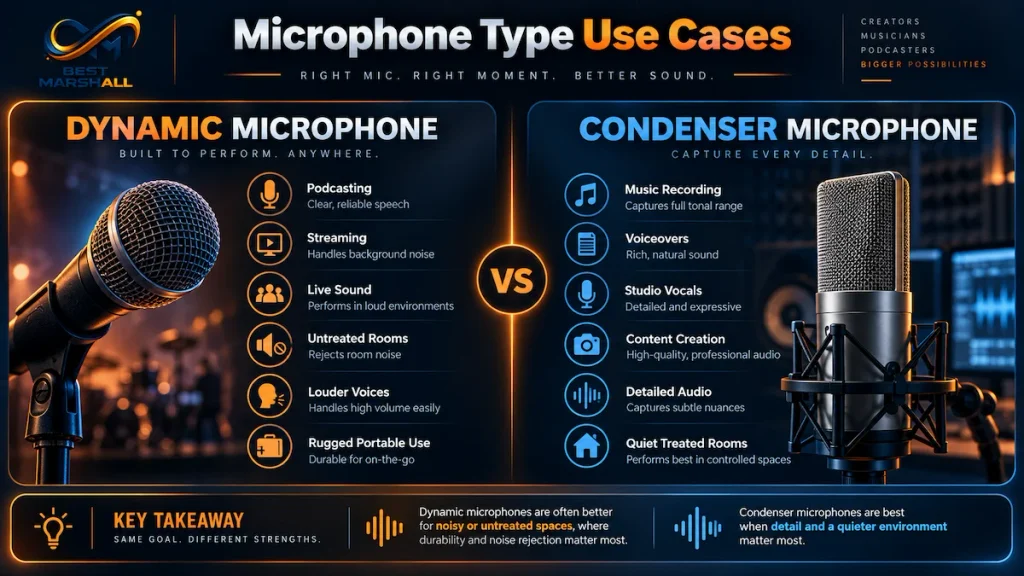
Choose a Dynamic Microphone If:
- you record speech close to the microphone;
- the room is acoustically untreated;
- keyboard and computer noise are nearby;
- you perform live;
- you record loud sources;
- durability matters;
- you prefer a broadcast-style workflow.
Choose a Condenser Microphone If:
- the room is quiet or treated;
- vocal and instrument detail are priorities;
- you record acoustic instruments;
- you need higher sensitivity;
- you record quieter sources;
- extended high-frequency response is desirable;
- your interface provides the required power.
These are tendencies, not restrictions.
Pre-Purchase Technical Checklist
Before choosing either type, answer the following.
What Are You Recording?
- spoken voice;
- singing;
- acoustic guitar;
- electric guitar amplifier;
- drums;
- room ambience;
- streaming;
- gaming.
What Is the Recording Environment?
- treated studio;
- quiet bedroom;
- reflective office;
- shared room;
- live stage;
- outdoor environment.
How Close Can the Microphone Be?
If it can remain a few inches from the mouth, a dynamic can be particularly practical.
If the microphone must capture a source from farther away, sensitivity and room acoustics become more important.
What Polar Pattern Do You Need?
Do not choose transducer technology before considering directionality.
What Does Your Interface Support?
Verify:
- XLR input;
- phantom power;
- clean gain;
- input impedance;
- monitoring.
Do You Need USB?
A USB microphone can simplify the entire system.
How Loud Is the Source?
Check maximum SPL when recording extremely loud sound.
How Quiet Is the Source?
For quiet sources, sensitivity and condenser self-noise become particularly relevant.
What Accessories Are Required?
Include the cost of:
- mount;
- stand;
- cable;
- interface;
- windscreen;
- pop filter;
- headphones.
Which Type Is Better for Different Creator Profiles?
Beginner Creator
Prioritize:
- easy setup;
- cardioid pickup;
- proper placement;
- direct monitoring if useful;
- compatibility with your computer.
A USB dynamic can be very convenient for streaming and podcasting.
A USB condenser can be equally sensible in a quiet room.
Intermediate Creator
Evaluate:
- sensitivity;
- polar pattern;
- preamp gain;
- self-noise;
- SPL;
- frequency response;
- room treatment.
At this stage, microphone choice should become source-specific.
Advanced Creator
Consider the complete electroacoustic chain:
- capsule topology;
- transient behavior;
- off-axis response;
- diaphragm size;
- sensitivity;
- equivalent noise level;
- maximum SPL;
- dynamic range;
- output impedance;
- preamp EIN;
- gain structure;
- proximity effect;
- room decay;
- source directivity.
At this level, “dynamic or condenser?” is only the beginning of microphone selection.
Technical FAQ
Is a dynamic microphone better than a condenser microphone?
No. Each technology has different strengths. The better choice depends on source, room, placement, gain requirements, and desired sound.
Which is better for podcasting: dynamic or condenser?
A close-positioned cardioid dynamic is often easier to manage in untreated podcasting rooms, while a condenser can provide excellent results in quieter or acoustically controlled spaces.
Which is better for streaming?
Dynamic microphones are popular for streaming because close placement can improve the voice-to-room ratio. Condensers can also work well with proper placement and room control.
Which microphone picks up less background noise?
Neither type automatically rejects more background noise solely because of its transducer technology. Polar pattern, distance, placement, source level, and room acoustics are major factors.
Why do condenser microphones seem more sensitive?
Their capsule and active electronics typically produce greater electrical output for a given acoustic sound pressure.
Do dynamic microphones need more gain?
Many do because they have lower sensitivity, but the amount varies substantially by model.
Does a condenser microphone need phantom power?
Professional XLR condensers commonly require phantom power, often +48V, but condensers can also receive power from batteries, USB, plug-in power, or dedicated supplies.
Does a dynamic microphone need phantom power?
A conventional passive moving-coil dynamic microphone normally does not.
Will phantom power damage a dynamic microphone?
Properly implemented phantom power generally does not harm modern balanced moving-coil dynamic microphones. Check manufacturer guidance for unusual, ribbon, legacy, damaged, or unbalanced equipment.
Are dynamic microphones good for vocals?
Yes. Dynamic microphones are extensively used for both live and recorded vocals.
Are condenser microphones good for vocals?
Yes. Condensers are extremely common for studio vocals because of their sensitivity and detailed response.
Are condenser microphones too sensitive for a bedroom?
Not necessarily. Proper close placement, cardioid orientation, gain settings, and basic acoustic treatment can make a condenser usable in a bedroom.
Which is better for an untreated room?
A close-positioned directional dynamic microphone is often easier to manage, but placement and polar pattern matter more than the label alone.
Which is better for acoustic guitar?
Condensers are commonly favored for capturing detailed transients and harmonic information, but dynamics can be useful when greater isolation or a different tonal character is desired.
Which is better for electric guitar amplifiers?
Dynamic microphones are extremely common because of their durability and high-SPL performance, although suitable condensers are also widely used.
Which is better for drums?
Both. Dynamics are common for close-miking drums, while condensers are common for overheads and room capture.
Do condenser microphones handle loud sound?
Many do. Check the published maximum SPL rather than assuming all condensers overload easily.
What is microphone self-noise?
Self-noise is noise generated by the microphone’s own active electronics, usually specified for condenser microphones as an equivalent sound-pressure level.
What is microphone sensitivity?
Sensitivity describes how much electrical output the microphone produces from a specified acoustic sound level.
Is higher microphone sensitivity better?
Not automatically. Higher sensitivity reduces required preamp gain but does not guarantee better sound or greater suitability.
Is higher maximum SPL always better?
No. It matters when recording very loud sources, but may be irrelevant for ordinary speech.
What is proximity effect?
Proximity effect is the increase in low-frequency response that occurs when many directional microphones are positioned very close to a source. It can occur with both dynamic and condenser microphones.
Do I need an audio interface?
For an XLR microphone, usually yes unless another mixer, recorder, or preamp system provides the necessary microphone input. USB microphones contain their own digital interface.
Can I connect an XLR microphone directly to a computer?
Not normally without an audio interface, mixer, or suitable XLR-to-digital device.
Is USB or XLR better?
Neither connector is inherently better. USB prioritizes simplicity; XLR provides greater flexibility for expandable recording systems.
Expert Conclusion: Dynamic or Condenser Microphone?
The difference between a dynamic microphone and a condenser microphone begins with the transducer.
A moving-coil dynamic generates its signal through a diaphragm, coil, and magnetic field.
A condenser uses a lightweight diaphragm and electrically charged backplate together with active electronics.
From those different operating principles come several typical characteristics.
Dynamic microphones generally provide:
- lower sensitivity;
- greater preamp-gain requirements;
- rugged construction;
- excellent high-SPL capability;
- strong suitability for close-mic speech and live applications.
Condenser microphones generally provide:
- higher sensitivity;
- lower required preamp gain;
- faster transient response;
- extended frequency response;
- a self-noise specification;
- strong suitability for detailed studio and acoustic recording.
But these are tendencies—not rigid rules.
Polar pattern determines directionality. Placement strongly affects room pickup. Working distance affects direct-to-ambient ratio. Interface quality affects low-output microphones. Maximum SPL varies by model. And modern examples of both technologies can perform far outside old stereotypes.
For many podcasters and streamers working in untreated home environments, a close-positioned directional dynamic microphone is the practical choice.
For creators working in controlled rooms who prioritize vocal or instrumental detail, a condenser often provides stronger technical advantages.
Once you know which microphone type better fits your room and recording style, compare our picks for the best USB microphones in 2026 to see which current models match those needs.
The correct pre-purchase question is therefore not simply:
“Which type sounds better?”
It is:
“Which microphone technology, polar pattern, sensitivity, gain requirement, and working distance best fit the source and room I actually need to record?”
Answer that question first, and the dynamic-versus-condenser decision becomes much easier.
2 thoughts on “Dynamic vs Condenser Microphone: Which Do You Need?”