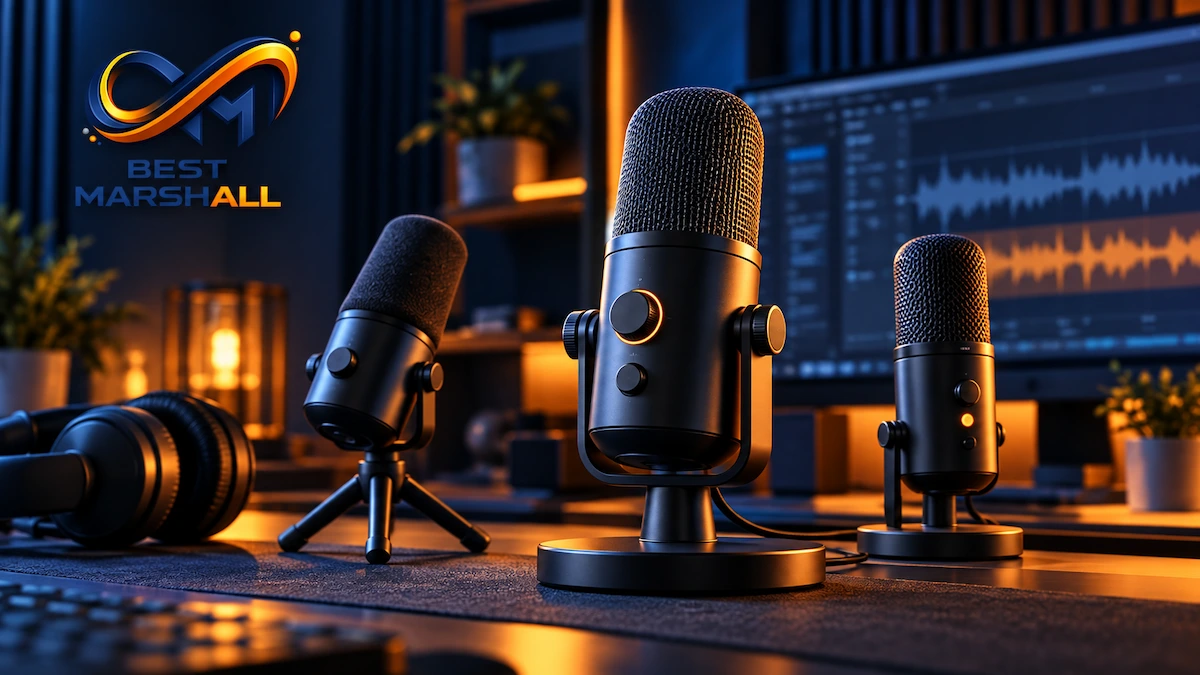
Buying a USB microphone in 2026 is no longer simply a choice between an inexpensive desktop mic and a professional XLR studio setup.
Modern creator microphones can include onboard DSP, automatic gain control, real-time denoising, zero-latency monitoring, software mixing, RGB lighting, multiple pickup patterns, and even both USB-C and XLR outputs in the same microphone.
That flexibility also makes choosing harder.
A sensitive condenser microphone can capture detailed vocals and instruments but may also reveal keyboard noise, computer fans, and room reflections. A dynamic microphone usually works best closer to the mouth and can be easier to manage in untreated rooms. Hybrid USB/XLR models provide an upgrade path into mixers and audio interfaces, while USB-only microphones can offer deeper software integration.
For this guide, Best Marshall analyzed official specifications, manufacturer documentation, current software capabilities, independent evaluations, market positioning, and relevant patterns in publicly available customer feedback. Best Marshall did not physically test these microphones.
The six models below serve noticeably different creator workflows. Here is where each one makes the strongest case.
1. Shure MV7+ — Best for Podcasting and Voice in Challenging Rooms
The Shure MV7+ is one of the most complete creator microphones in this comparison.
It is a cardioid dynamic microphone designed primarily around spoken voice, with both USB-C and XLR connectivity. That alone makes it useful for creators who want to begin with a simple computer connection and later move into an audio interface or mixer.
What separates the MV7+ from less expensive hybrid microphones is the amount of processing available when using USB.
Shure includes Auto Level Mode, a real-time Denoiser, Digital Popper Stopper, compression, limiting, a high-pass filter, tone adjustment, and other DSP functions. The customizable LED touch panel also doubles as a level display and tap-to-mute interface.
This combination makes the MV7+ particularly relevant for podcasters and streamers recording in normal bedrooms, offices, or gaming rooms rather than acoustically treated studios.
Technical Specifications
- Microphone type: Dynamic — generally well suited to close-mic speech and less sensitive to distant room sound than many condensers.
- Polar pattern: Cardioid — emphasizes sound from the front while reducing pickup from other directions.
- Frequency response: 50Hz–16kHz — focused appropriately around speech and vocal content.
- Digital resolution: 16- or 24-bit at 48kHz
- USB-C maximum SPL: 128dB SPL
- USB-C and XLR outputs — supports both plug-and-play and traditional audio-interface workflows.
- 3.5mm headphone output — enables direct monitoring.
- Adjustable digital gain: 0 to +36dB
- Onboard DSP: Auto Level Mode, Digital Popper Stopper, real-time Denoiser, compressor, limiter, high-pass filter, tone adjustment, and reverb.
- Software: Shure MOTIV Mix on desktop plus compatible MOTIV mobile applications.
- Mount: Standard 5/8-inch thread
Main Benefits
- Excellent voice-oriented DSP: Automatic level adjustment and real-time noise processing can simplify spoken-word recording.
- USB and XLR in one microphone: Beginners can start without an interface and retain the microphone when upgrading later.
- Dynamic capsule suits imperfect rooms: Particularly relevant for streamers surrounded by keyboards, PC fans, and reflective walls.
- Direct monitoring: Useful for podcasts, voiceovers, and streams where hearing your own signal without software delay matters.
- Integrated plosive management: Digital Popper Stopper reduces reliance on a large external pop filter in camera-facing setups.
Things to Consider
- Premium price positioning: Buyers with straightforward needs can obtain USB/XLR connectivity for considerably less with the FIFINE AM8.
- 24-bit/48kHz specification is not unusually high on paper: The QuadCast 2 S and AT2020USB-X support higher numerical sample rates, although those numbers alone do not establish better voice quality.
- Close placement remains important: Like most broadcast-style dynamic microphones, the MV7+ performs best when positioned appropriately near the speaker.
- Its most advanced functions depend on the USB/DSP workflow: XLR use shifts processing responsibilities to external equipment.
Final Product Verdict
Best Marshall’s analysis suggests the Shure MV7+ makes the most sense for podcasters, streamers, voiceover creators, and other users recording speech in ordinary home environments who want powerful processing without abandoning the option of XLR later. Its primary trade-off is cost, but the combination of dynamic voice capture, hybrid connectivity, and unusually comprehensive onboard DSP makes that premium easier to justify for serious creators.
2. RØDE PodMic USB — Best Hybrid USB/XLR Microphone for a Broadcast-Style Workflow
The RØDE PodMic USB takes a more traditional broadcast-microphone approach.
Like the Shure, it is a cardioid dynamic microphone with both USB-C and XLR outputs. RØDE pairs the USB connection with its Revolution Preamp and APHEX processing system, including tools such as compression, noise gate, high-pass filtering, Aural Exciter, and Big Bottom processing.
An internal pop filter and internal shockmount are built into the microphone, and RØDE also includes an external pop filter.
Its construction is another distinguishing factor. The PodMic USB uses an all-metal enclosure and weighs approximately 900 grams, making it substantially heavier than many desktop USB microphones.
That weight is beneficial for robustness but also means a suitable microphone arm or stand deserves serious consideration.
Technical Specifications
- Microphone type: Dynamic
- Polar pattern: Cardioid
- Address type: End-address
- Frequency response: 20Hz–20kHz
- Maximum SPL: 148dB
- Digital resolution: 24-bit / 48kHz
- Outputs: USB-C and three-pin XLR
- 3.5mm headphone connection
- Zero-latency monitoring
- Onboard APHEX DSP
- USB preamp: RØDE Revolution Preamp
- Internal pop filter and internal shockmount
- External pop filter included
- Weight: Approximately 900 g / 1.98 lb
- Software compatibility: RØDE Central, RØDE Connect, RØDE Capture, and UNIFY
- Mobile support: Compatible with supported iOS and Android devices
- Manufacturer warranty: Five years under RØDE’s current coverage for this model
Main Benefits
- Strong upgrade path: USB works for simple creator setups, while XLR allows integration with studio mixers and interfaces.
- Broadcast-oriented physical design: Its end-address layout works naturally on a boom arm positioned near the mouth.
- Useful onboard processing: APHEX tools provide meaningful control before audio reaches streaming or recording software.
- Mechanical noise management: Internal shock isolation and pop filtering address two common spoken-word recording problems.
- Robust construction: The all-metal housing is intended for long-term creator and studio use.
Things to Consider
- Heavy microphone: Nearly two pounds can challenge inexpensive boom arms.
- No colorful touch interface or elaborate visual controls: Buyers who value gaming aesthetics may prefer the HyperX or FIFINE.
- Less automatic than the Shure: The MV7+ offers more explicit automatic voice-processing features for users who want the microphone to make more decisions for them.
- A proper mounting solution may increase the total setup cost.
Final Product Verdict
The PodMic USB is especially compelling for creators who want a traditional broadcast-style microphone that can move naturally between USB recording and a future XLR studio setup. Compared with the MV7+, it emphasizes ruggedness, conventional broadcast positioning, and RØDE’s processing ecosystem rather than extensive automatic DSP. It is particularly appropriate for podcasting, voiceover work, and spoken-word production.
3. Elgato Wave:3 MK.2 — Best for Streamers and Software-Based Audio Routing
The Elgato Wave:3 MK.2 approaches creator audio from a very different direction.
It is a USB-only condenser microphone rather than a hybrid dynamic model. Its defining advantage is the integration between microphone hardware, onboard processing, and Wave Link, Elgato’s audio-routing and mixing software.
The current MK.2 generation adds onboard Wave FX processing, Auto Gain, Clipguard 2.0, real-time monitoring, and deeper integration with Wave Link and Stream Deck.
Wave Link can create multiple independent mixes for uses such as streaming, recording, personal monitoring, and calls. It also supports VST effects and application-level routing.
For streamers juggling game audio, voice chat, music, browser audio, alerts, and microphone processing simultaneously, those software capabilities can matter more than whether the microphone records at 48kHz or 96kHz.
Technical Specifications
- Microphone type: 16mm condenser
- Polar pattern: Cardioid according to Elgato’s current U.S. specifications
- Resolution: 24-bit
- Sample rate: 48kHz
- Frequency response: 70Hz–20kHz
- Maximum SPL: 130dB SPL
- Dynamic range: 110dB
- Connection: USB-C
- Headphone output: 3.5mm
- Real-time monitoring
- Wave FX Processor with onboard DSP
- Clipguard 2.0
- Auto Gain
- Wave Link integration with multiple independent audio mixes
- VST effects support through Wave Link
- Stream Deck integration
- Weight: Approximately 0.55 lb without stand / 1.26 lb with stand
Main Benefits
- Excellent streaming ecosystem: Audio routing is a genuine differentiator rather than an additional checkbox.
- Onboard DSP: Reduces dependence on the computer for core voice processing.
- Clipguard: Designed to reduce the risk of clipping when vocal level suddenly rises.
- Stream Deck integration: Particularly useful for creators already using Elgato hardware.
- Compact USB workflow: No separate interface, XLR cable, or mixer is required.
Things to Consider
- Condenser sensitivity: It may capture more room reflections, keyboard sound, and environmental noise than a close-positioned dynamic microphone.
- USB only: There is no XLR path if you later build a conventional hardware studio.
- Wave Link is central to the value proposition: Buyers who do not need advanced routing may not benefit as much from the Elgato ecosystem.
- Windows and macOS requirements should be checked: The current MK.2 software platform targets relatively recent operating systems.
Final Product Verdict
The Wave:3 MK.2 is the strongest fit for streamers whose audio setup extends beyond the microphone itself. If you need to route games, chat, browser audio, music, effects, and your own voice into separate mixes, its software ecosystem is more important than raw specification comparisons. For untreated rooms or podcast-only setups, a dynamic MV7+, PodMic USB, or AM8 may be easier to manage acoustically.
4. Audio-Technica AT2020USB-X — Best for Detailed Voice and Music Recording in Quiet Rooms
The Audio-Technica AT2020USB-X is the most traditional studio-style condenser in this comparison.
It is based on the long-running AT2020 concept but adds USB-C connectivity, direct headphone monitoring, a computer/microphone mix control, touch-sensitive mute, and digital conversion up to 24-bit/96kHz.
Unlike the Shure and RØDE hybrid microphones, it does not offer XLR output.
Unlike the Elgato, it does not center its identity on elaborate DSP and streaming software.
Instead, its strongest argument is straightforward: a cardioid condenser with a broad 20Hz–20kHz frequency response and higher-resolution USB recording for users who want detailed capture of speech, vocals, and acoustic sources.
Independent evaluation by SoundGuys reinforces the central trade-off: the AT2020USB-X can capture detailed audio but, like other sensitive condensers, can also reveal more ambient noise in untreated environments.
Technical Specifications
- Microphone type: Permanently polarized condenser
- Polar pattern: Cardioid
- Frequency response: 20Hz–20kHz
- Bit depth: 16- or 24-bit
- Sample rates: 44.1, 48, 88.2, and 96kHz
- Output: USB-C
- Headphone output: 3.5mm
- Headphone amplifier: Up to 110mW under specified load conditions
- Direct monitoring
- Mix control: Blends computer playback and live microphone audio.
- Touch-sensitive mute
- Weight: Approximately 13 oz / 373 g
- Included desktop stand and thread adapter
Main Benefits
- Detailed condenser capture: Well suited to quiet recording rooms where sensitivity is an advantage rather than a problem.
- 24-bit/96kHz capability: Gives users more recording-format flexibility than 48kHz-only alternatives.
- Direct monitor mix: Particularly useful when recording vocals or instruments over existing tracks.
- Straightforward hardware controls: Headphone level, mix, and mute are available directly on the microphone.
- Broad creator applications: Appropriate for podcasts, voiceovers, vocals, acoustic instruments, and home-studio recording.
Things to Consider
- No XLR output: It does not provide the same hardware upgrade path as the Shure, RØDE, or FIFINE.
- Sensitive to the room: Keyboard noise, reflections, HVAC systems, and computer fans can become more prominent.
- No major onboard DSP ecosystem: Buyers wanting automatic denoising, compression, or elaborate processing will need software.
- A quiet or acoustically controlled recording space matters more here than with a close-positioned dynamic microphone.
Final Product Verdict
The AT2020USB-X is particularly compelling for creators recording in reasonably quiet rooms who value natural detail and may record music as well as speech. It is less forgiving than the dynamic microphones in noisy environments, but that same sensitivity can become an advantage for vocals and acoustic sources when the room is controlled.
5. FIFINE AM8 — Best Value for USB/XLR Streaming and Podcasting
The FIFINE AmpliGame AM8 is difficult to ignore from a value perspective.
It is a dynamic cardioid microphone with both USB and XLR outputs, a 3.5mm monitoring connection, onboard USB gain and headphone controls, tap-to-mute functionality, selectable RGB lighting, and a desktop stand.
Its frequency response is rated from 50Hz to 16kHz, closely matching the speech-focused range used by significantly more expensive broadcast-style microphones.
FIFINE also recommends close end-address positioning at approximately 2 to 6 inches, which is consistent with the intended dynamic-microphone workflow.
The biggest distinction is what the AM8 does not include: there is no advanced software-processing ecosystem comparable to Shure MOTIV, RØDE APHEX, or Elgato Wave Link.
For many beginners, that may be an acceptable compromise.
Technical Specifications
- Microphone type: Dynamic
- Polar pattern: Cardioid
- Frequency response: 50Hz–16kHz
- Maximum SPL: 120dB
- Signal-to-noise ratio: Greater than 80dB
- Connectivity: USB and XLR
- 3.5mm headphone monitoring
- Mic gain control in USB mode
- Headphone-volume control in USB mode
- Tap-to-mute in USB mode
- RGB lighting
- 3/8-inch and 5/8-inch stand compatibility
- Desktop stand included in the standard configuration
- PS5 compatibility through USB; Xbox USB audio is not supported
- AM8 itself is not compatible with FIFINE Genie software
Main Benefits
- Exceptional feature-to-cost ratio: USB/XLR connectivity is unusual at this price level.
- Dynamic capsule: A sensible choice for gaming rooms and untreated home environments.
- Direct monitoring: An important creator feature that some budget microphones omit.
- Hardware controls: Gain, mute, and headphone volume reduce dependence on operating-system menus.
- Upgrade path: XLR allows future use with an audio interface without replacing the microphone.
- Creator-oriented aesthetics: RGB provides an additional visual option for camera-facing gaming setups.
Things to Consider
- USB controls do not carry over to XLR operation: RGB, mute, and associated function controls depend on the digital USB side.
- No advanced software ecosystem: The standard AM8 does not work with FIFINE Genie.
- No sophisticated onboard DSP: Noise reduction, compression, and EQ generally need to happen elsewhere.
- Build and processing sophistication are more basic than the premium Shure and RØDE alternatives.
Final Product Verdict
The FIFINE AM8 has the strongest case for buyers seeking an affordable dynamic microphone that can start as plug-and-play USB and later move into XLR. It does not match the MV7+ or PodMic USB in processing sophistication, but the core creator features are remarkably complete for its tier. For beginners, budget-conscious streamers, and first-time podcasters, that makes it the clearest Best Value candidate in this group.
6. HyperX QuadCast 2 S — Best for Multi-Pattern Recording and RGB Gaming Setups
The HyperX QuadCast 2 S is fundamentally different from the dynamic broadcast microphones above.
It uses three 14mm condenser capsules to support four selectable pickup patterns:
- cardioid;
- omnidirectional;
- bidirectional;
- stereo.
That makes it far more adaptable when one microphone needs to perform different jobs.
Cardioid can handle solo streaming. Bidirectional can capture two people sitting opposite each other. Omnidirectional can record a discussion around the microphone. Stereo can be useful when spatial information matters.
The current QuadCast 2 S also pushes digital specifications unusually far for a gaming microphone, supporting up to 32-bit / 192kHz, although higher numbers alone should not be confused with automatically better recordings.
Its other defining feature is extensive addressable RGB lighting controlled through HyperX NGENUITY.
Technical Specifications
- Microphone type: Three 14mm electret condenser capsules
- Polar patterns: Cardioid, omnidirectional, bidirectional, and stereo
- Bit depths: 16-, 24-, and 32-bit
- Sample rates: 44.1, 48, 96, and 192kHz
- USB connection: USB-C cable with USB-A adapter
- 3.5mm headphone monitoring
- Tap-to-mute sensor
- Multifunction control knob
- Detachable shock mount
- Addressable RGB lighting
- Software: HyperX NGENUITY on Windows
- Compatibility: PC and Mac
- Manufacturer warranty: Two years
Main Benefits
- Four polar patterns: No other microphone in this comparison provides the same recording-pattern flexibility.
- High digital resolution options: Useful for creators who specifically need higher sample-rate workflows.
- Integrated shock mount: Helps isolate some desk and mechanical vibration without requiring an immediate accessory purchase.
- Tap-to-mute operation: Well suited to livestreaming and gaming.
- Highly customizable RGB: Visually distinctive for camera-facing setups.
- Simple pattern switching: Allows one microphone to cover several creator scenarios.
Things to Consider
- Condenser sensitivity: Like the Audio-Technica and Elgato, it can capture more surrounding room sound than close-mic dynamic alternatives.
- Four patterns are unnecessary for many creators: A solo streamer who always uses cardioid may be paying for flexibility that never gets used.
- NGENUITY customization is Windows-focused.
- 32-bit/192kHz should not drive the purchase by itself: Room acoustics, capsule behavior, microphone technique, and placement remain more important to perceived recording quality.
- USB only: No XLR upgrade path is provided.
Final Product Verdict
The QuadCast 2 S is the strongest option here for creators who want multiple pickup patterns, direct monitoring, integrated shock isolation, and a highly visible RGB gaming aesthetic in one USB microphone. It is particularly appropriate for streamers who also record interviews or group content. Creators who only record one close voice in a noisy room have stronger reasons to choose a dynamic model.
USB Microphones Compared: Which One Fits Your Creator Setup?
| Product | Type | Connection | Max Digital Format | Patterns | Key Advantage | Best For | Main Limitation |
|---|---|---|---|---|---|---|---|
| Shure MV7+ | Dynamic | USB-C + XLR | 24-bit / 48kHz | Cardioid | Extensive onboard voice DSP | Podcasting, streaming, untreated rooms | Premium price |
| RØDE PodMic USB | Dynamic | USB-C + XLR | 24-bit / 48kHz | Cardioid | Broadcast build + APHEX processing | Podcasts, voiceovers, hybrid studio setups | Heavy; benefits from a good arm |
| Elgato Wave:3 MK.2 | Condenser | USB-C | 24-bit / 48kHz | Cardioid | Wave Link routing and onboard DSP | Streaming and complex PC audio | No XLR; more room-sensitive |
| Audio-Technica AT2020USB-X | Condenser | USB-C | 24-bit / 96kHz | Cardioid | Detailed studio-style capture | Vocals, instruments, quiet rooms | No XLR or advanced onboard DSP |
| FIFINE AM8 | Dynamic | USB + XLR | Verify exact digital format on current listing | Cardioid | USB/XLR capability at low cost | Beginners, gaming, budget podcasting | Limited software/DSP |
| HyperX QuadCast 2 S | Condenser | USB-C | Up to 32-bit / 192kHz | Cardioid, omni, bidirectional, stereo | Four patterns + RGB | Gaming, streaming, flexible recording | No XLR; sensitive to room noise |
The Shure MV7+ has the strongest feature set for voice-focused creators who want automatic processing and a hybrid upgrade path.
The PodMic USB provides a more traditional broadcast workflow with especially robust construction and RØDE’s APHEX processing.
The Wave:3 MK.2 makes its strongest case outside the capsule itself: Wave Link can become the center of a sophisticated streaming-audio setup.
The AT2020USB-X is better suited to creators who want condenser detail for vocals and acoustic sources.
The FIFINE AM8 covers an unusually large portion of the fundamental creator requirements at a much lower price tier.
And the QuadCast 2 S is the specialist when selectable polar patterns and visual customization matter.
How to Choose the Best USB Microphone
1. Choose Dynamic or Condenser Based on Your Room
For most buyers, this decision matters more than sample rate.
A dynamic microphone usually requires closer placement and tends to be easier to manage when the room contains:
- mechanical keyboards;
- computer fans;
- other people;
- hard reflective walls;
- traffic or HVAC noise.
That makes the MV7+, PodMic USB, and AM8 logical choices for many home streamers and podcasters.
A condenser microphone is generally more sensitive and can capture greater detail from quieter sources.
That can benefit:
- singing;
- acoustic instruments;
- nuanced voice work;
- controlled studio recording.
The AT2020USB-X, Wave:3 MK.2, and QuadCast 2 S fall into this group.
If you are still deciding which microphone type better suits your room and recording style, our guide to dynamic vs condenser microphones explains the differences in more detail.
2. Decide Whether You Need XLR Later
USB is simpler.
XLR is more expandable.
If you eventually expect to use:
- an audio interface;
- hardware mixer;
- multi-microphone podcast system;
- professional recording console;
a hybrid microphone can prevent you from replacing the mic later.
The Shure MV7+, RØDE PodMic USB, and FIFINE AM8 all provide USB and XLR.
If you know your workflow will remain computer-based, USB-only microphones can be equally logical.
3. Prioritize Monitoring and Hardware Controls
Direct monitoring allows you to hear your own voice from the microphone without waiting for audio to travel through recording software and back.
That helps identify:
- clipping;
- mouth noise;
- plosives;
- background sounds;
- incorrect gain;
- poor positioning.
A convenient headphone connection and accessible gain or monitoring controls can provide more day-to-day value than an extremely high sample-rate specification.
4. Decide How Much DSP and Software You Actually Need
The microphones here range from almost hardware-only to deeply software-integrated.
The Shure MV7+ offers extensive voice DSP.
RØDE provides APHEX processing.
Elgato’s Wave Link is particularly strong for routing multiple computer-audio sources.
The AT2020USB-X keeps processing comparatively simple.
The standard FIFINE AM8 provides basic onboard controls without a major software environment.
Choose based on your workflow rather than assuming more software is always better.
5. Do Not Buy Based on Sample Rate Alone
A 192kHz specification is impressive on a comparison chart.
It does not automatically make a microphone sound better than a 48kHz model.
For streaming, podcasts, YouTube, and most video production, 24-bit/48kHz is already a highly capable format.
What often matters more is:
- capsule quality;
- microphone type;
- polar pattern;
- distance from the mouth;
- room acoustics;
- gain structure;
- processing;
- performance technique.
The QuadCast 2 S offers the highest maximum numerical format here, but that does not automatically make it the best microphone for a podcast.
For a deeper breakdown of microphone type, connectivity, monitoring, DSP, recording environment, and other buying criteria, see our complete guide on how to choose a USB microphone.
USB Microphone Placement Matters More Than Many Upgrades
Even a premium microphone can perform poorly when positioned incorrectly.
For spoken voice:
- place the microphone relatively close to the mouth;
- speak toward the correct side or end of the capsule;
- reduce gain rather than placing a sensitive mic several feet away;
- use a pop filter or windscreen when necessary;
- move the microphone away from keyboard vibration;
- consider a boom arm when the included desktop stand places the mic too far from your voice.
Dynamic microphones such as the MV7+, PodMic USB, and AM8 are especially dependent on appropriate close placement.
Conversely, condenser microphones may need greater attention to room reflections and environmental noise.
Where to Buy These USB Microphones
The commercial purchase destination for this Best Marshall guide is Amazon US.
Before ordering, verify the seller, exact microphone model, included stand or accessories, color or configuration, current price, warranty information, and applicable return terms.
Shure MV7+
RØDE PodMic USB
Elgato Wave:3 MK.2
Audio-Technica AT2020USB-X
FIFINE AM8
HyperX QuadCast 2 S
Check the current Amazon listings for the models you’re considering to confirm availability, exact configuration, seller information, and current pricing before making your final decision.
Which USB Microphone Should You Choose in 2026?
For serious podcasting and voice-focused creator work, the Shure MV7+ has the most complete combination of dynamic voice capture, USB/XLR flexibility, automatic gain, denoising, plosive processing, monitoring, and software control.
The RØDE PodMic USB is an excellent alternative for creators who prefer a rugged broadcast-style microphone and want RØDE’s APHEX processing with a clear path toward XLR studio equipment.
For streaming, the Elgato Wave:3 MK.2 becomes particularly compelling because Wave Link can manage much more than the microphone itself.
The Audio-Technica AT2020USB-X makes more sense for creators working in quieter spaces who want detailed condenser capture for vocals, instruments, and voice.
Budget-conscious creators get an unusually capable hybrid package from the FIFINE AM8, while the HyperX QuadCast 2 S provides the greatest polar-pattern flexibility for gaming, streaming, interviews, and visually customized setups.
The best USB microphones are therefore not determined by sample rate alone. Start with your room, your voice or recording source, and your workflow—then choose the microphone whose trade-offs actually match them.
Frequently Asked Questions
Which USB microphone makes more sense for an untreated room?
A dynamic model is generally the easier starting point when room noise and reflections are concerns, especially when used close to the speaker. In this list, the Shure MV7+, RØDE PodMic USB, and FIFINE AM8 use dynamic capsules. The MV7+ also adds real-time denoising and a digital pop filter through its onboard DSP. Proper microphone distance and placement still matter regardless of the model. Shure
Which microphones let me start with USB and upgrade to XLR later?
The Shure MV7+, RØDE PodMic USB, and FIFINE AM8 all provide both USB and XLR connectivity. That makes them particularly useful for creators who want plug-and-play recording now but may later add an audio interface or mixer. The main trade-off is that some USB-specific controls or processing may not carry over identically when the microphone is used through its analog XLR output.
Which microphone is better for recording more than one person?
The HyperX QuadCast 2 S offers the most flexible pickup-pattern options in this group for that type of use. It provides cardioid, omnidirectional, bidirectional, and stereo patterns, while several other microphones here are primarily designed around directional single-speaker capture. For a regular two-person podcast, however, two separate microphones usually provide greater control than sharing one microphone.
Which microphone makes the most sense for a software-heavy streaming setup?
The Elgato Wave:3 MK.2 is particularly well aligned with that workflow because it integrates with Elgato’s Wave Link software for audio routing, effects, monitoring, and DSP control. That can be valuable for streamers managing microphone audio alongside game sound, music, chat, and other sources. Buyers who prefer minimal software dependence may value simpler hardware-focused options instead.
Is the Audio-Technica AT2020USB-X better suited to a quiet recording space?
It can be a strong fit for a more controlled room. The AT2020USB-X uses a cardioid condenser design and provides USB-C connectivity, direct headphone monitoring, mix control, and recording up to 24-bit/96 kHz. Condenser microphones can capture detailed speech and vocals, but that sensitivity also makes microphone placement and room acoustics especially important when unwanted sound or reflections are present.
Does 32-bit/192 kHz make the HyperX QuadCast 2 S sound better than the others?
Not automatically. The QuadCast 2 S supports recording resolutions up to 32-bit/192 kHz, but bit depth and sample rate are only part of a microphone system. Capsule design, polar pattern, DSP, microphone position, room acoustics, speaking technique, and the intended platform also affect the result. Higher numerical specifications should therefore not be treated as a universal sound-quality ranking.
Do I need an audio interface with any of these microphones?
No, not when using their USB connections. Every microphone in this roundup can connect digitally to a compatible computer without requiring a separate audio interface. An interface becomes relevant if you choose to use the XLR output available on models such as the Shure MV7+, RØDE PodMic USB, or FIFINE AM8, or if you later build a multi-microphone XLR setup.
One thought on “6 Best USB Microphones in 2026 for Streaming, Podcasting and Recording”