
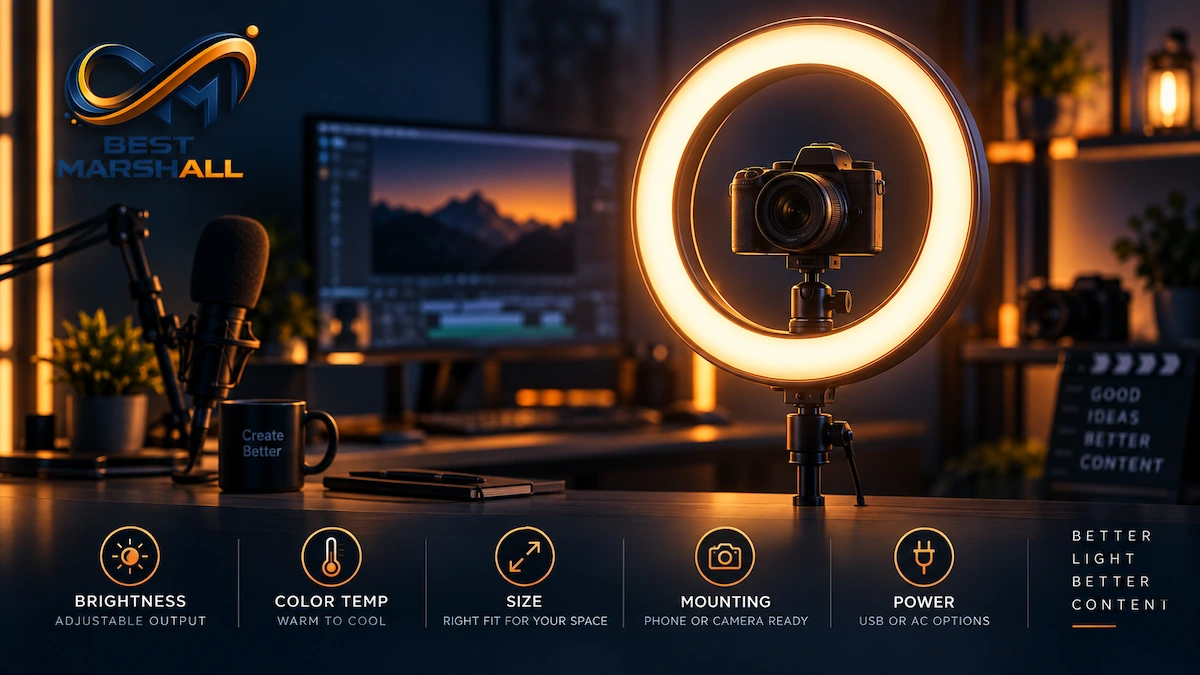
A ring light can improve the way you look on camera, but buying one based only on diameter or the number of LEDs can lead to disappointing results.
Two models may both be advertised as 18-inch lights while producing very different brightness, color accuracy, diffusion, stability, and control. A compact light may be perfect for video calls but underpowered for full-body content. A large kit may provide plenty of illumination while becoming frustrating because of a weak tripod or unstable phone mount.
The right ring light depends on what you create, how far the light will sit from you, what camera or phone you use, and how much control you need over brightness and color temperature.
For this guide, Best Marshall analyzed current manufacturer specifications, creator-lighting documentation, independent evaluations, product positioning, and recurring patterns in publicly available customer feedback.
Here is what matters before you buy.
What Is a Ring Light?
A ring light is a circular lighting fixture designed to place a relatively even source of light around or close to the camera lens.
Its shape can reduce some facial shadows while creating the familiar circular reflection sometimes visible in the eyes.
Ring lights are commonly used for:
- YouTube videos;
- TikTok and Reels;
- livestreaming;
- video calls;
- makeup tutorials;
- beauty content;
- photography;
- product demonstrations;
- interviews;
- smartphone content creation.
Most modern versions use LEDs because they can provide adjustable brightness with relatively low power consumption and heat compared with older lighting technologies.
Some models mount directly on a desk. Others use full-height tripods, clamps, or creator-oriented mounting systems.
How Does a Ring Light Work?
A ring light surrounds the camera position with LEDs or places the camera near the center of the circle.
Because light reaches the subject from many points around the lens axis, shadows can appear softer than they would under a small, direct light source positioned off to one side.
The practical result depends on several variables:
- diameter of the light;
- diffusion;
- distance from the subject;
- brightness;
- color temperature;
- placement;
- ambient room light.
Moving a ring light closer increases its apparent size relative to the subject, which generally produces softer illumination while also increasing brightness on the face.
Move it farther away, and more output may be necessary.
That is why a powerful, adjustable light usually gives creators more flexibility than a small lamp with only a few fixed brightness settings.
Ring Light Specifications That Actually Matter
| Feature | What to Look For |
|---|---|
| Diameter | Match the size to framing and working distance |
| Brightness | Adjustable output with enough power for your setup |
| CRI | Prefer high color accuracy for skin tones and products |
| Color temperature | Adjustable warm-to-cool white light is more flexible |
| Dimming | Fine brightness control rather than only a few steps |
| Diffusion | Helps soften individual LED sources |
| Stand | Stable at the height you plan to use |
| Phone mount | Secure grip and portrait/landscape rotation |
| Camera mount | Standard 1/4-inch mounting support when needed |
| Power | AC, USB, USB-C, or battery depending on mobility needs |
| Controls | Physical, remote, app, or wireless control |
| Tilt | Enough adjustment to position the light correctly |
| Portability | Folding stand or carrying case when travel matters |
Do not assume more LEDs automatically mean better lighting.
Output, diffusion, color quality, and placement matter more than LED count alone.
What Ring Light Size Should You Buy?
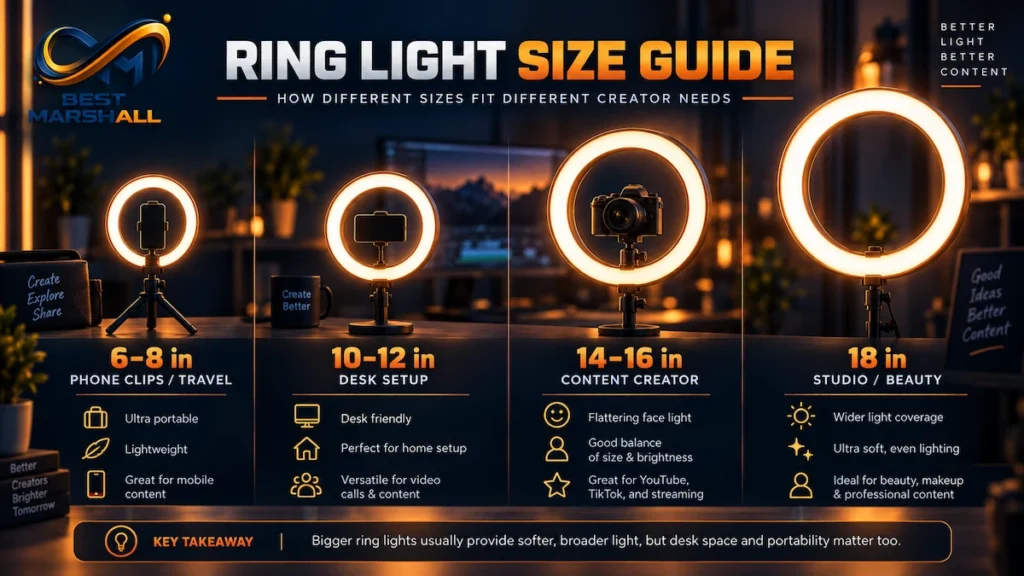
Size should match the type of content you create.
Small Ring Lights
Compact desktop models are useful for:
- video calls;
- close-up smartphone videos;
- small desks;
- casual streaming;
- portable setups.
Their main limitation is output and coverage.
A small light positioned close to the face can work well, but it may struggle when moved several feet away.
Mid-Size Ring Lights
Mid-size models offer a useful compromise between portability and coverage.
They can work for:
- seated YouTube videos;
- livestreaming;
- beauty content;
- desk-based content creation;
- head-and-shoulders framing.
Large Ring Lights
Creator kits around the larger end of the category are better suited to:
- standing content;
- beauty work;
- portraits;
- wider framing;
- situations where the light needs to sit farther from the subject.
Current professional-style examples show why size alone is not enough: 17- and 18-inch models can combine outputs above 2,000 lumens or several thousand lux at short distances, high CRI ratings, and wide dimming ranges.
The relevant question is whether you need that output for your actual shooting distance.
CRI: Why Color Accuracy Matters
CRI stands for Color Rendering Index.
It describes how accurately a light source reproduces colors compared with a reference light source.
The scale runs to 100.
For content creation, higher CRI is especially useful when you care about:
- natural-looking skin tones;
- makeup colors;
- clothing;
- artwork;
- product photography;
- food;
- branded colors.
Current creator-focused ring lights commonly advertise CRI values above 90, with better models often reaching around 94 or 95.
Brightness alone cannot compensate for poor color rendering.
A very bright light that shifts skin tones toward green or makes product colors inaccurate can create more editing work later.
Color Temperature: Warm vs. Cool Light
Color temperature is measured in Kelvin.
Lower values appear warmer and more yellow or amber.
Higher values appear cooler and more blue-white.
Creator-focused ring lights commonly offer adjustable ranges somewhere between warm indoor-style light and cooler daylight-style output.
For example, current models may offer ranges such as approximately:
- 2900K–7000K;
- 3200K–5600K.
A wide adjustable range is valuable because it helps you match the ring light to:
- window light;
- household lamps;
- studio lights;
- different visual styles.
Mixing very warm room lighting with a very cool ring light can produce inconsistent skin tones unless the camera’s white balance compensates successfully.
Check out the 6 best ring lights in 2026.
Brightness: Lumens and Lux Are Not the Same Thing
Brightness specifications can be confusing.
Lumens describe the total amount of visible light produced.
Lux describes the amount of light reaching a specific area.
Lux measurements only make sense when the manufacturer also states the distance.
For example, a specification such as “5,500 lux at 0.5 meter” provides much more useful information than a lux number without a measurement distance.
When comparing models, do not compare:
- lumens from one product;
- lux from another;
as though they measure exactly the same thing.
For creators, adjustable brightness is usually more important than maximum output alone.
A powerful light with 0–100% dimming provides more flexibility than a light that is always too bright at close range.
Diffusion Matters More Than Many Buyers Realize
LEDs are small, concentrated light sources.
A well-designed diffuser spreads that output across the ring and helps create smoother illumination.
Poor diffusion can produce:
- visible LED hotspots;
- harsh reflections;
- less flattering skin;
- uneven catchlights.
Higher-end designs may use multiple diffusion layers rather than simply exposing LEDs behind a thin translucent cover.
For beauty videos, interviews, and close-up content, diffusion should be treated as a meaningful feature rather than a cosmetic detail.
Stand Stability Can Make or Break the Kit
One of the clearest patterns in customer feedback across ring-light products is that the light itself can be good while the included stand is disappointing.
Reported problems commonly involve:
- narrow tripod footprints;
- lightweight legs;
- wobbling at full height;
- weak adjustment points;
- phone mounts that shift position;
- top-heavy setups.
This becomes especially important with larger ring lights and heavy smartphones.
Before buying, examine:
- maximum stand height;
- width of the tripod base;
- construction material;
- locking mechanisms;
- phone-mount position;
- total weight of the light.
A taller stand is not automatically better if it becomes unstable when fully extended.
Phone and Camera Mounting
For smartphone creators, check whether the included holder supports:
- your phone’s width;
- its case;
- portrait orientation;
- landscape orientation;
- secure angle adjustment.
For camera users, look for a standard 1/4-inch mounting screw, which is common across photographic accessories.
Also consider weight.
A mount that handles a smartphone may not be suitable for a mirrorless camera with a heavy lens.
If you already own a dedicated tripod, you may prefer a light that allows the camera and lighting to be mounted separately.
How to Position a Ring Light
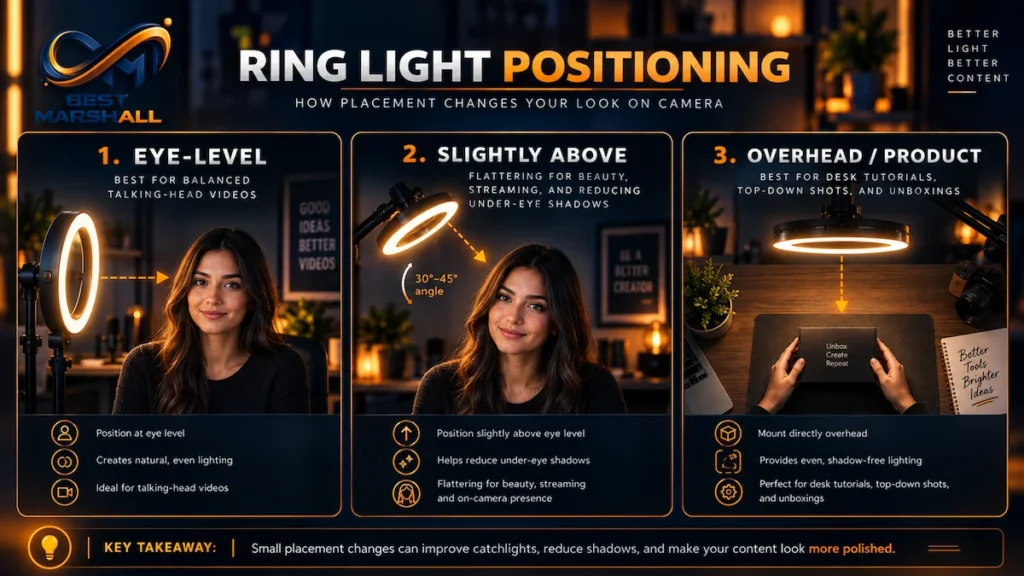
A practical starting setup is:
- Place the light directly in front of you.
- Position the camera near the center of the ring when appropriate.
- Start with moderate brightness rather than maximum output.
- Match the color temperature to the surrounding light.
- Raise the light slightly above eye level.
- Angle it gently downward if needed.
- Adjust the distance until facial shadows look natural.
- Lock the stand and phone or camera mount securely.
- Check exposure and white balance on camera before recording.
Do not assume brighter always looks better.
Excessive front lighting can flatten facial features and create an unnatural appearance.
Moving the light slightly off-axis can add more shape when a perfectly flat beauty-lighting look is not desired.
Main Benefits of a Ring Light
Simple lighting setup: One fixture can provide useful front lighting without requiring a multi-light studio.
Adjustable appearance: Dimming and color-temperature controls make it easier to adapt to different rooms.
Useful for smartphones: Many kits combine lighting, phone mounting, and tripod functions.
Consistent creator lighting: Artificial light reduces dependence on changing daylight.
Compact compared with larger studio systems: A ring light can provide broad frontal illumination without multiple stands and softboxes.
If a traditional ring light feels too large for your desk, our Logitech Litra Glow review covers a more compact alternative.
Things to Consider Before Buying
A Ring Light Is Not Always the Best Key Light
Ring lights create a distinctive front-lit look.
For cinematic interviews, dramatic portraits, or content where facial dimension matters, a larger softbox or LED panel positioned off-camera may provide more control.
Ring lights are tools—not universally superior lighting.
Cheap Kits Often Compromise on the Stand
Public customer feedback repeatedly shows mixed opinions about the stands included with inexpensive kits.
If you plan to use the light daily, paying attention to tripod construction and mounting hardware can be as important as checking the LEDs.
RGB May Be Unnecessary
Colored RGB effects can be useful for creative backgrounds or stylized content.
But if your main goal is accurate skin tones, interviews, makeup, or product demonstrations, high-quality white light, adjustable color temperature, strong CRI, and good diffusion may matter much more.
Warranty and Support
Warranty coverage varies by manufacturer.
Before purchasing, check:
- warranty duration;
- U.S. customer support;
- availability of replacement power adapters;
- replacement mounting hardware;
- app support if the light uses wireless controls;
- compatibility of proprietary accessories.
For products with integrated Wi-Fi or app control, firmware and software support also become relevant.
If buying through Amazon, verify the exact product configuration, seller, included stand and mounting accessories, warranty information, and current return terms before ordering.
What Are Users Saying About Ring Lights?
Public customer feedback shows several recurring patterns.
Buyers commonly praise:
- adjustable brightness;
- selectable warm and cool light;
- improved appearance on video calls;
- more consistent lighting for social content;
- included phone holders;
- convenient remote controls.
Recurring complaints often focus less on the LEDs and more on the hardware surrounding them.
Some buyers report:
- flimsy tripods;
- unstable phone holders;
- top-heavy designs;
- limited stand height;
- weak plastic adjustment mechanisms.
This is why a buying decision should consider the complete kit rather than the ring itself.
Is a Ring Light Worth Buying?
A ring light can make a lot of sense for creators who want a simple, relatively compact front-lighting solution.
Consider One If You Create:
- YouTube videos;
- TikToks or Reels;
- livestreams;
- beauty tutorials;
- makeup content;
- video calls;
- smartphone portraits;
- talking-head videos.
You May Want Another Lighting Setup If:
- you need dramatic directional lighting;
- you frequently light more than one person;
- you shoot large rooms;
- you want strong background separation;
- you need professional multi-light control.
Final Buying Advice
When choosing a ring light, prioritize the specifications that affect the image and the reliability of the setup.
Start with:
- enough output for your working distance;
- high color accuracy;
- adjustable color temperature;
- smooth dimming;
- good diffusion;
- a stable stand and secure mount.
Then decide whether you actually need RGB effects, app control, wireless remotes, battery operation, or elaborate accessories.
For most creators, a well-built bi-color light with high CRI, good diffusion, reliable dimming, and a stable support system is more useful than a feature-heavy model attached to a weak tripod.
If a ring light matches your camera or phone setup and the type of content you create, check its current pricing and availability on Amazon before making your final decision.
Examples of what buyers will encounter:
Frequently Asked Questions
Are ring lights good for people who wear glasses?
They can be, but reflections may become a problem. Because a ring light surrounds the camera, its circular reflection can appear prominently in eyeglass lenses. Moving the light slightly higher, farther away, or off the camera axis can reduce glare. If glasses are a major part of your workflow, a conventional LED panel placed at an angle may sometimes be easier to control.
Can one ring light light two people at the same time?
Sometimes, but coverage becomes more difficult as subjects move farther apart. Ring lights are most effective when the subject is relatively centered, so two people can receive uneven illumination if they sit outside the brightest area. A larger light placed farther back can improve coverage, but creators regularly filming two people may benefit from a broader key light or multiple-light setup.
Is a ring light good for full-body videos?
It can work, but ring lights are generally better suited to closer framing. For full-body shots, the light must usually be positioned farther from the subject, which reduces its intensity and changes the characteristic ring-light effect. Larger, more powerful lights are better suited to wider framing. Our ring light size guide explains how diameter and shooting distance affect practical coverage.
Does CRI matter when choosing a ring light?
Yes, especially when accurate color reproduction matters. CRI, or Color Rendering Index, describes how naturally a light source renders colors compared with a reference source. Higher-quality lighting can be particularly useful for makeup tutorials, product demonstrations, fashion content, and other color-sensitive work. However, CRI should be considered alongside brightness, color temperature control, placement, and camera white balance.
Can I use a ring light with a DSLR or mirrorless camera?
Yes, but check the mounting system and physical clearance first. Many ring lights include smartphone holders, while camera mounting may require a separate tripod, bracket, or compatible center mount. Larger cameras and lenses can also affect how easily the lens fits within the ring. For creators using interchangeable-lens cameras, mounting flexibility can matter as much as the light itself.
Is a battery-powered ring light better than a plug-in model?
Not necessarily. Battery-powered models offer portability and are useful when outlets are unavailable, but runtime becomes another limitation to manage. Plug-in ring lights are generally more convenient for fixed streaming, video calls, or studio-style setups where continuous operation matters. Some models support both power options, which can provide more flexibility for creators who work both at a desk and on location.
Is RGB worth having on a ring light?
Only if colored lighting supports the content you create. RGB can be useful for backgrounds, creative effects, streaming aesthetics, or social media content, but it adds little value if your main goal is natural-looking facial illumination. For everyday video calls, tutorials, or product demonstrations, adjustable brightness and white color temperature are usually more important than decorative color effects.
2 thoughts on “How to Choose a Ring Light: Complete Buying Guide for Creators in 2026”