Choosing a Bluetooth speaker sounds simple until you start comparing products. Some are small enough to clip onto a backpack, while others weigh several pounds and are designed to fill a backyard or large room. Battery estimates range widely, waterproof ratings differ, and features such as stereo pairing, EQ, multipoint, USB-C audio, and Auracast can make two similarly sized speakers behave very differently.
The first question should not be “Which speaker is the loudest?”
It should be where and how you plan to use it.
A speaker for a desk, bedroom, or podcast does not need the same bass output, durability, or battery capacity as one intended for poolside parties or camping.
For this guide, Best Marshall analyzed current Bluetooth standards, manufacturer specifications, independent speaker testing, connectivity requirements, and recurring patterns in publicly available customer feedback.
Here is what matters before you buy.
What Is a Bluetooth Speaker?
A Bluetooth speaker is a powered speaker that receives audio wirelessly from a compatible device such as a:
- smartphone;
- tablet;
- laptop;
- television;
- portable media player.
Portable models typically include rechargeable batteries, while larger home or party speakers may depend partly or entirely on AC power.
Bluetooth allows audio playback without relying on Wi-Fi or an internet connection, which is one reason these speakers are especially useful outdoors and while traveling.
Depending on the model, additional features may include:
- stereo pairing;
- multi-speaker playback;
- app-based EQ;
- speakerphone capability;
- USB-C charging;
- power-bank functionality;
- AUX input;
- Wi-Fi;
- voice assistants;
- lighting effects.
The best model depends on which of those features actually matter to your setup.
How Does a Bluetooth Speaker Work?
Bluetooth speakers receive compressed digital audio wirelessly from a paired source.
The speaker then converts that signal into sound through its internal amplifier and drivers.
A typical portable design may contain:
- one or more active drivers;
- tweeters for higher frequencies;
- woofers or mid-bass drivers;
- passive radiators for additional low-frequency output;
- an internal amplifier;
- a rechargeable battery;
- Bluetooth hardware;
- digital signal processing.
DSP, or digital signal processing, is particularly important in compact speakers. Manufacturers use it to manage bass, protect small drivers at high volumes, and shape the overall sound.
This is why judging a speaker only by driver size or advertised wattage can be misleading.
Actual sound quality depends on the complete acoustic design.
Bluetooth Speaker Specifications That Actually Matter
| Feature | What to Evaluate |
|---|---|
| Size and weight | Match portability to expected sound output |
| Battery life | Consider real use, not only maximum claims |
| IP rating | Important for outdoor, pool, and beach use |
| Bluetooth version | Useful, but features matter more than the version number alone |
| Bluetooth range | Important for outdoor and large-room use |
| Multipoint | Allows easier switching between multiple source devices |
| Codecs | May affect compatibility, quality, or latency |
| EQ support | Useful for adjusting bass, mids, and treble |
| Stereo pairing | Allows two compatible speakers to create left/right channels |
| Multi-speaker support | Useful for parties or larger spaces |
| USB-C | Preferable for modern charging convenience |
| AUX input | Valuable for wired devices and lower-latency use |
| Speakerphone | Relevant if you plan to make calls |
| Power-bank mode | Can charge a phone from some larger speakers |
No single specification tells you whether a speaker sounds good.
Independent frequency-response, loudness, distortion, and battery testing can provide much more useful context than marketing numbers alone.
Start With Speaker Size
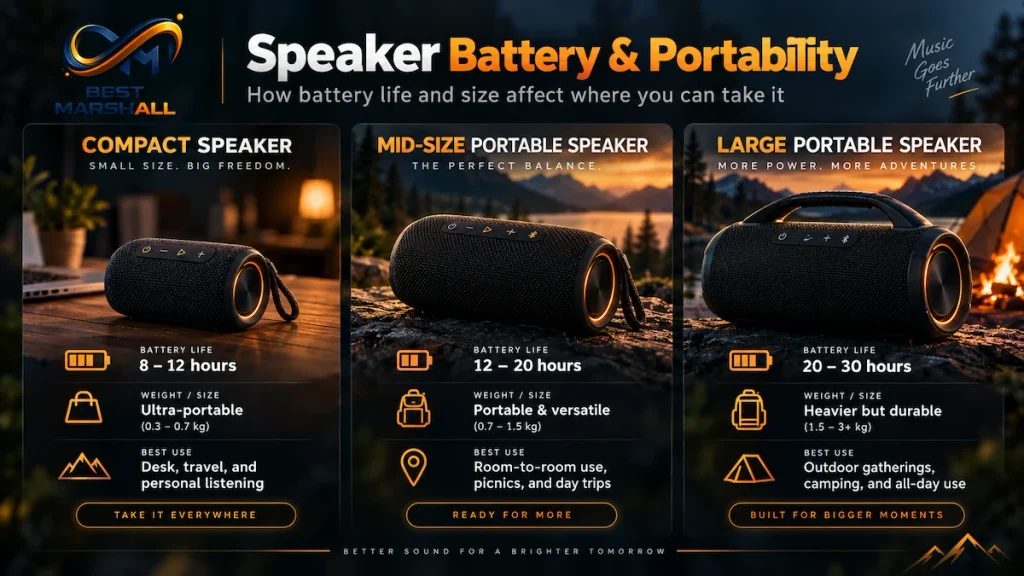
Size is one of the strongest predictors of the compromises a Bluetooth speaker will make.
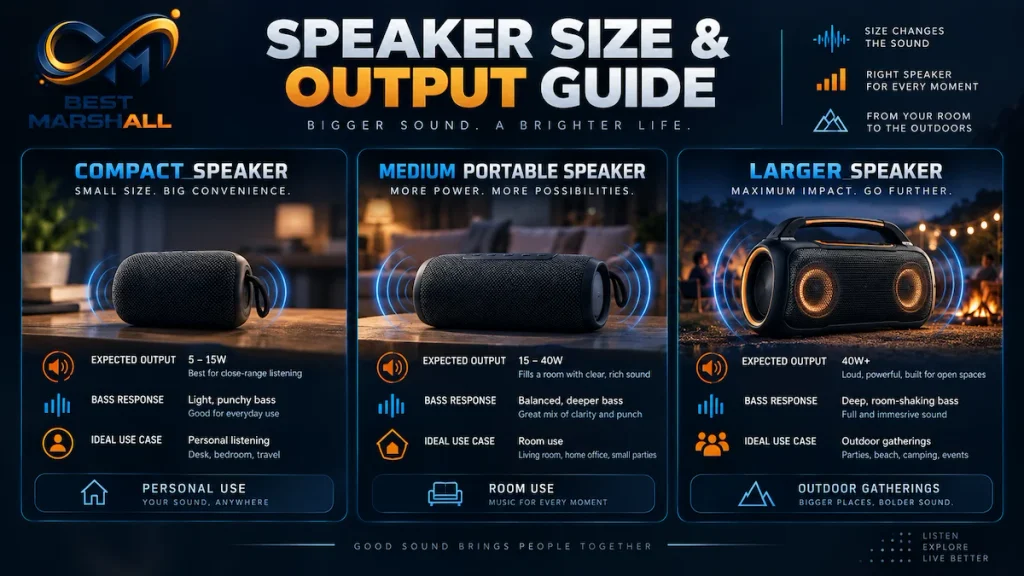
Small Portable Speakers
Compact models prioritize portability.
They are useful for:
- desks;
- bedrooms;
- personal listening;
- travel;
- backpacks;
- podcasts and background music.
Their limitation is physics.
Very small speakers generally cannot reproduce deep bass or fill large outdoor spaces as effectively as larger models.
Medium Portable Speakers
Mid-size models often provide the best compromise for general use.
They may be portable enough for a picnic or vacation while still producing enough bass and volume for a living room or small gathering.
Independent speaker testing regularly shows that this middle category offers a practical balance between portability, sound output, and battery life.
Large and Party Speakers
Large models can produce deeper bass and substantially higher output.
They are better suited to:
- backyard gatherings;
- garages;
- parties;
- large rooms;
- outdoor events.
The trade-off is obvious: more weight and less portability.
Some party speakers also add microphone inputs, instrument inputs, wheels, handles, or lighting effects.
Sound Quality: What Should You Look For?
Sound quality is more complicated than bass quantity.
A good speaker should ideally provide balanced reproduction across:
- bass;
- midrange;
- treble.
Bass
Larger enclosures usually have an advantage in low-frequency extension.
Tiny speakers can create surprisingly strong upper bass through DSP and passive radiators, but they cannot fully overcome physical limitations.
If deep bass matters, consider a larger enclosure.
Midrange
Vocals, podcasts, guitars, and much of the musical information people hear most clearly occupy the midrange.
A speaker with excessive bass can make voices sound recessed or muddy.
Treble
Treble contributes detail and clarity.
Too little can sound dull, while too much can become harsh.
EQ Can Be Very Useful
App-based EQ allows you to adjust the tuning for:
- your musical preferences;
- room placement;
- outdoor listening;
- quieter listening levels.
More advanced speakers may offer multi-band EQ rather than basic bass and treble controls.
Battery Life: Read the Fine Print
Manufacturer battery ratings should be treated as estimates rather than guarantees.
Runtime depends heavily on:
- volume;
- EQ;
- lighting effects;
- temperature;
- wireless features;
- connected devices;
- battery age.
A current example illustrates why volume matters: Bose rates one portable model for around 20 hours at moderate volume but only about three hours at maximum volume.
Independent speaker testing also shows that portable speakers commonly span roughly 15 to 30 hours at moderate use, although individual models vary significantly.
For outdoor use, prioritize enough runtime for your actual day rather than chasing the largest number on the box.
Also check:
- charging time;
- USB-C charging;
- fast charging;
- whether playback is possible while charging.
IP Ratings for Outdoor Use
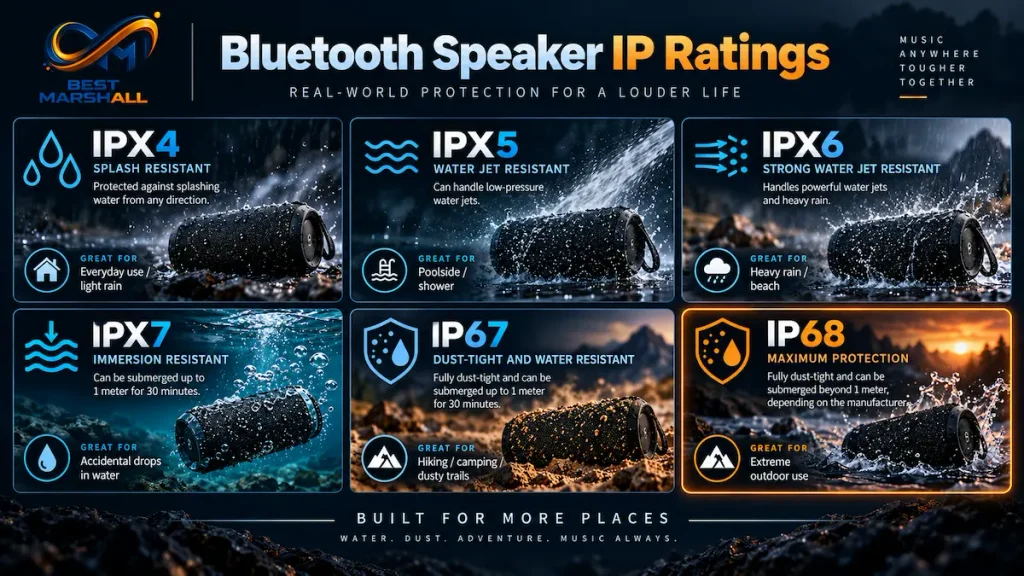
If your speaker will travel to the pool, beach, campsite, or backyard, check its IP rating.
The rating indicates standardized protection against dust and water.
Current rugged portable models commonly offer ratings such as:
- IP67;
- IP68.
Do not simply assume “waterproof” means the same thing across products.
Check the exact manufacturer’s rating and limitations.
A water-resistant speaker designed for splashes may not have the same protection as one certified for temporary immersion.
Also remember that saltwater, pool chemicals, sand, and repeated exposure can present additional challenges even for rugged electronics.
Bluetooth Range, Multipoint, and Latency
Bluetooth performance involves more than whether a speaker connects.
Range
A longer reliable range matters when the phone stays on a table while the speaker moves around a backyard or large room.
Walls and interference can reduce real-world distance.
Multipoint
Multipoint allows a speaker to maintain connections with more than one device.
This can be useful when switching between:
- phone and laptop;
- two family members’ phones;
- work and personal devices.
Latency
Latency is the delay between the source and the sound.
It is usually irrelevant for music.
It can become noticeable when watching:
- movies;
- YouTube;
- games.
Independent testing shows that latency can also vary by operating system and app because some software compensates for Bluetooth delay automatically.
Bluetooth Codecs and LE Audio
Most buyers do not need to choose a speaker based exclusively on codecs, but they are worth understanding.
Common audio codecs may include:
- SBC;
- AAC;
- LDAC;
- aptX variants;
- LC3.
Support depends on both the source device and speaker.
A high-end codec provides little benefit if your phone does not support it.
LE Audio and LC3
Bluetooth LE Audio introduces the LC3 codec, designed to provide more efficient audio transmission than older Bluetooth approaches.
According to the Bluetooth SIG, LC3 can offer improved quality at lower data rates, potentially allowing manufacturers to balance audio quality and power consumption more effectively.
This does not mean every new Bluetooth speaker automatically supports LE Audio or LC3.
Check the exact model.
What Is Auracast?
Auracast is one of the more interesting developments in Bluetooth audio.
It uses Bluetooth LE Audio broadcast technology to allow a compatible source to transmit audio to multiple nearby compatible receivers.
For speakers, this can enable new ways of sharing or expanding audio beyond traditional one-to-one Bluetooth pairing.
However, Auracast compatibility should be verified across the complete setup.
A speaker supporting Auracast does not automatically mean every phone or laptop you own can use every Auracast function immediately.
If multi-speaker expansion matters, also check whether the manufacturer uses:
- Auracast;
- a proprietary linking system;
- traditional stereo pairing.
Stereo Pairing vs. Multi-Speaker Linking
These features are not necessarily the same.
Stereo Pairing
Two compatible speakers can become distinct left and right channels.
This improves stereo separation and is particularly useful for music listening.
Multi-Speaker Linking
Several speakers may play the same audio simultaneously.
This is better for:
- parties;
- multiple rooms;
- larger outdoor areas.
Before buying multiple speakers, verify that the exact models can link together. Manufacturers sometimes change pairing technologies between generations.
How to Set Up a Bluetooth Speaker
A typical setup involves:
- Charge the speaker fully.
- Turn it on.
- Activate Bluetooth pairing mode.
- Open Bluetooth settings on the phone, tablet, or computer.
- Select the speaker.
- Install the manufacturer’s app if needed.
- Apply firmware updates.
- Adjust EQ or listening modes.
- Configure multipoint or additional speakers if supported.
For better sound, avoid placing a speaker where objects block its drivers.
Placement can also affect bass. A speaker close to walls or corners may produce more low-frequency energy than the same speaker in an open area.
Main Benefits of a Bluetooth Speaker
Wireless convenience: No audio cable is required for normal playback.
Portability: Battery-powered models can move between rooms or outdoors.
No internet requirement: Bluetooth playback can work without Wi-Fi.
Flexible size options: Buyers can choose anything from pocket models to large party systems.
Expandable audio: Some models support stereo pairs or multiple linked speakers.
Outdoor durability: Rugged models can combine battery power with meaningful water and dust resistance.
Things to Consider Before Buying
Small Speakers Cannot Break the Laws of Physics
A very compact model may sound impressive for its size, but buyers expecting deep, powerful bass at party volume should consider a larger speaker.
Maximum Volume Reduces Battery Life
Battery estimates are often based on moderate playback.
Running a speaker near maximum output can reduce runtime substantially.
An IP Rating Does Not Make a Speaker Indestructible
Rugged construction helps, but drops, corrosion, heat, and improper charging can still damage the device.
Bluetooth Version Alone Is Not Enough
A speaker with a newer Bluetooth version is not automatically better.
Evaluate the actual supported features:
- range;
- codecs;
- multipoint;
- LE Audio;
- Auracast;
- latency.
Warranty and Support
Before purchasing, check:
- warranty duration;
- U.S. manufacturer support;
- firmware-update availability;
- battery-service policies;
- replacement-part availability;
- app compatibility.
Battery longevity becomes especially important for products expected to last several years because rechargeable lithium-ion batteries naturally lose capacity over time.
If purchasing through Amazon, verify the exact model, seller, included accessories, warranty information, and current return terms before ordering.
What Are Users Saying About Bluetooth Speakers?
Across publicly available customer feedback, buyers frequently praise:
- portability;
- convenient wireless playback;
- battery life;
- strong sound relative to size;
- water resistance;
- app-based EQ.
Recurring complaints commonly involve:
- battery life below expectations at high volume;
- Bluetooth connection interruptions;
- weaker-than-expected bass from small speakers;
- apps that require accounts or permissions;
- difficulty pairing multiple speakers;
- proprietary pairing systems changing between generations.
These patterns reinforce the importance of buying for a specific use case rather than choosing solely by brand or advertised maximum output.
Is a Bluetooth Speaker Worth Buying?
A Bluetooth speaker makes the most sense for users who want audio that can move easily between devices and locations.
Consider One If You Want:
- portable music around the home;
- outdoor audio;
- travel-friendly playback;
- audio without relying on Wi-Fi;
- battery-powered listening;
- a simple speaker for a phone or tablet.
Consider Another Type of Speaker If You Need:
- permanent multi-room Wi-Fi audio;
- a full stereo hi-fi system;
- dedicated home-theater sound;
- very deep bass at high output;
- professional PA capability.
Final Buying Advice
Do not begin with Bluetooth version or wattage.
Start with size and intended use.
Then evaluate:
- sound quality and bass capability;
- battery life;
- water and dust resistance;
- portability;
- Bluetooth range and multipoint;
- stereo or multi-speaker expansion;
- app and EQ functionality.
Once you know which features matter most for your listening needs, compare our picks for the best Bluetooth speakers in 2026.
For personal or desk listening, a smaller model may be enough.
For general indoor and outdoor use, a mid-size portable speaker often offers the best balance.
For large gatherings, bass-heavy music, and high output, a larger boombox or party-style speaker makes more sense.
If a Bluetooth speaker matches your listening environment, portability needs, and desired features, check its current pricing and availability on Amazon before making your final decision.
[AMAZON PRODUCT LINK — ADD MANUALLY]
Frequently Asked Questions
Can I use a Bluetooth speaker with my TV?
Yes, if your TV can send audio to Bluetooth speakers, but compatibility is only part of the equation. Wireless audio can introduce noticeable delay between the picture and sound, depending on the TV, speaker, and Bluetooth implementation. If lip-sync matters for movies or gaming, check the TV’s audio settings and the speaker’s supported connection options before relying on Bluetooth as your primary TV audio system.
Does a newer Bluetooth version automatically mean better sound quality?
No. A newer Bluetooth version can enable newer capabilities, but it does not guarantee that one speaker will sound better than another. Drivers, enclosure design, DSP, tuning, supported audio codecs, and implementation all matter. Technologies such as Bluetooth LE Audio introduce newer audio capabilities, but both the source and receiving device must support the relevant features for you to benefit from them.
Can I pair Bluetooth speakers from different brands together?
Usually not through each brand’s proprietary stereo or party-pairing system. Many manufacturers design multi-speaker features to work only with compatible models within their own ecosystem. Newer technologies such as Auracast can enable compatible transmitters to broadcast audio to multiple supported receivers, but you should not assume that any two Bluetooth speakers can be linked simply because both support Bluetooth.
Will a Bluetooth speaker work without Wi-Fi or internet?
Yes. Standard Bluetooth playback creates a direct wireless connection between the source device and the speaker, so Wi-Fi or internet access is not required for locally stored audio. Internet access may still be necessary for the music service you are streaming from or for additional smart features. This distinction makes ordinary Bluetooth speakers useful in places where no Wi-Fi network is available.
Does where I place a Bluetooth speaker affect how it sounds?
Yes, sometimes significantly. Walls, corners, hard surfaces, speaker orientation, and listening distance can all affect perceived bass, clarity, and stereo presentation. Placing a speaker tightly against a wall or in a corner can reinforce some low frequencies, while obstructing its drivers can reduce clarity. Placement therefore deserves consideration even when the speaker itself has strong specifications.
Is an IP67 Bluetooth speaker safe to use in the ocean?
Not automatically. An IP67 rating describes standardized protection against dust and temporary freshwater immersion under specified test conditions; it does not mean unlimited protection against saltwater, chlorine, waves, or every outdoor environment. Salt and chemicals can also affect materials and connectors. Check the manufacturer’s care instructions before using a waterproof speaker at the beach or pool.
Should I leave a Bluetooth speaker plugged in all the time?
Only if the manufacturer indicates that continuous plugged-in use is appropriate for that model. Portable speakers use rechargeable batteries and may manage charging differently. If the speaker is intended primarily for portable use, prolonged heat and unnecessary battery stress are worth considering. Buyers planning permanent desktop use should also check whether the model can operate normally from external power without creating inconvenient charging behavior.