If you are shopping for premium noise-canceling headphones in 2026, there is a good chance the Sony WH-1000XM6 and Bose QuietComfort Ultra Headphones (2nd Gen) are near the top of your list.
Both target travelers, commuters, office workers, and serious music listeners willing to pay for flagship-level active noise cancellation, wireless features, comfort, and sound quality. They also share several fundamentals: foldable over-ear designs, Bluetooth multipoint, strong ANC, transparency modes, app-based customization, analog connectivity, and roughly 30 hours of manufacturer-rated battery life.
But the similarities hide meaningful differences.
Sony emphasizes detailed and dynamic sound, advanced customization, LDAC and LC3 support, strong microphone performance, and an adaptive 12-microphone noise-canceling system. Bose counters with exceptional comfort, USB-C digital audio, aptX Adaptive through Snapdragon Sound, CustomTune processing, and its distinctive Immersive Audio system.
For this Bose QuietComfort vs Sony WH-1000XM6 comparison, Best Marshall analyzed official specifications, manufacturer documentation, independent professional testing, current market positioning, and recurring patterns in publicly available customer feedback. Best Marshall did not physically test or use either model.
The better choice depends heavily on what you value most.
Sony WH-1000XM6 vs Bose QuietComfort Ultra 2: Quick Comparison
| Feature | Sony WH-1000XM6 | Bose QuietComfort Ultra Headphones (2nd Gen) |
|---|---|---|
| Type | Premium wireless over-ear ANC headphones | Premium wireless over-ear ANC headphones |
| Weight | Approx. 8.96 oz | Approx. 9.33 oz |
| ANC | Adaptive ANC with QN3 processor and 12-microphone system | Adaptive ANC with Bose CustomTune and ActiveSense technologies |
| Manufacturer-rated battery | Up to 30 hr ANC on / 40 hr ANC off | Up to 30 hr |
| Immersive/spatial battery | Varies by features and settings | Up to 23 hr with Immersive Audio |
| Bluetooth | 5.3 | 5.4 |
| Multipoint | Yes | Yes |
| Main Bluetooth codecs | SBC, AAC, LDAC, LC3 | SBC, AAC, aptX Adaptive |
| USB-C audio playback | No | Yes |
| Analog audio | Yes, 3.5 mm | Yes, 2.5 mm-to-3.5 mm cable |
| Spatial audio | Sony spatial/360 audio ecosystem | Bose Immersive Audio |
| Movie-focused spatial mode | No direct equivalent to Bose Cinema Mode | Cinema Mode |
| App | Sony Sound Connect | Bose app |
| Foldable design | Yes | Yes |
| Best strength | Sound detail, calls, customization, codec flexibility | Comfort, ANC experience, USB-C audio, Immersive Audio |
| Main limitation | No USB-C digital audio | Less extensive EQ/control customization |
| Best for | Music, calls, power users, Android LDAC users | Travel, long sessions, comfort-first users, USB-C listening |
Quick Recommendation
Choose the Sony WH-1000XM6 if you prioritize:
- detailed, dynamic music reproduction;
- strong voice-call performance;
- extensive sound customization;
- LDAC or LC3 support;
- slightly lower weight;
- a highly configurable app experience;
- Sony’s adaptive ANC system.
Choose the Bose QuietComfort Ultra Headphones (2nd Gen) if you prioritize:
- maximum long-session comfort;
- deeper and more accommodating earcups;
- USB-C digital audio;
- aptX Adaptive with compatible Snapdragon Sound devices;
- Bose Immersive Audio;
- Cinema Mode for movies and video;
- a simpler premium listening experience.
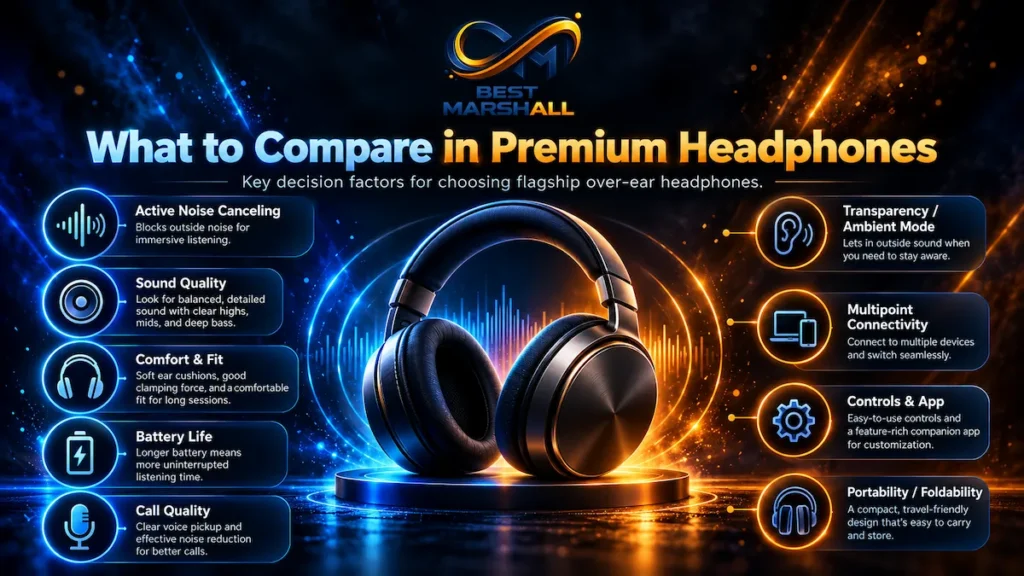
Neither model wins every category, and the ANC difference is close enough that fit, comfort, sound preferences, and connectivity may matter more than small differences in isolation measurements.
Design and Build Quality
Sony and Bose both use foldable premium over-ear designs, but they take somewhat different approaches.
The Sony WH-1000XM6 weighs approximately 8.96 ounces, making it slightly lighter than the Bose.
Sony also brought back a folding hinge after the WH-1000XM5 moved away from the compact folding mechanism used on earlier generations. That makes the XM6 considerably easier to pack into its carrying case for travel.
The headband is relatively slim, while the earcups use Sony’s familiar low-profile oval design.
The Bose QuietComfort Ultra Headphones (2nd Gen) weigh approximately 9.33 ounces. Bose combines plastic construction with aluminum components, polished metal yokes, protein-leather cushions, and a padded headband.
The Bose also folds inward for transport.
Despite being slightly heavier on paper, independent testing generally favors Bose for comfort across a wider range of users.
RTINGS, for example, found the Bose more accommodating overall, while also describing the Sony as lightweight and comfortable. One reason is earcup geometry: Bose’s cups tend to provide more space around the ear, which can matter for people with larger ears, glasses, or sensitivity to contact around the outer ear.
Which Is Better for Comfort?
For many users, Bose has the comfort advantage.
That does not mean the Sony is uncomfortable. Independent reviews consistently describe the XM6 as lightweight and suitable for long listening sessions.
But Bose’s QuietComfort name remains appropriate: its combination of plush cushioning, cup depth, and relatively moderate pressure makes it particularly attractive for flights, office work, and extended listening.
Which Is More Portable?
This is effectively a tie.
Both models fold and include protective carrying cases.
Sony is slightly lighter, while Bose’s folding structure remains highly travel-friendly.
Build Quality and Long-Term Durability
Both headphones occupy premium price tiers, but neither relies on heavy metal construction.
Sony redesigned the folding mechanism for the XM6 and markets the new hinge as part of the improved portable design.
Long-term feedback around the Sony hinge is mixed.
Some owners have reported hinge or material-related problems, and Tom’s Guide described the articulating hinge as relatively fragile-feeling in its review. Other long-term owners report no hinge problems and describe the XM6 mechanism as sturdier than previous Sony generations.
That evidence is not strong enough to conclude that the WH-1000XM6 has a widespread structural defect.
It is reasonable, however, to treat the hinge as an area worth protecting, especially given the history of durability discussions surrounding earlier Sony models.
Bose uses a combination of plastic, aluminum, and protein leather in the QuietComfort Ultra 2nd Gen. The generation is also relatively recent, so extensive multi-year reliability evidence is still developing.
For either model, using the included protective case during travel is sensible.
Active Noise Cancellation: Sony vs Bose
This is the category most buyers care about, and it is also where declaring a universal winner would be misleading.
Both are among the strongest consumer ANC headphones available.
Sony WH-1000XM6 ANC
Sony’s system uses its HD Noise Canceling Processor QN3, which the company says processes information considerably faster than the processor used in the WH-1000XM5.
The system manages 12 microphones and continuously adjusts cancellation based on environmental noise, wearing conditions, and atmospheric pressure.
Sony also provides Adaptive NC Optimizer and automatic ambient-sound adjustments.
Independent testing supports the conclusion that the XM6 provides exceptional isolation.
RTINGS’ direct 2026 comparison between the Sony and Bose found the Sony to provide slightly stronger overall noise isolation, although the difference was close.
What Hi-Fi also found the Sony particularly effective against low-frequency and midrange environmental noise and praised the way its ANC operates without making the listening environment feel unnaturally pressured.
Bose QuietComfort Ultra 2nd Gen ANC
Bose has built much of its reputation around active noise cancellation.
The second-generation QuietComfort Ultra uses Bose’s adaptive noise-control technologies together with CustomTune, which calibrates aspects of the listening experience based on the acoustic characteristics around the listener’s ears.
Independent reviews consistently place the Bose among the strongest ANC headphones available.
Tom’s Guide described its noise cancellation as exceptionally effective, while RTINGS measured superb isolation across a wide range of environmental sounds.
ANC Verdict
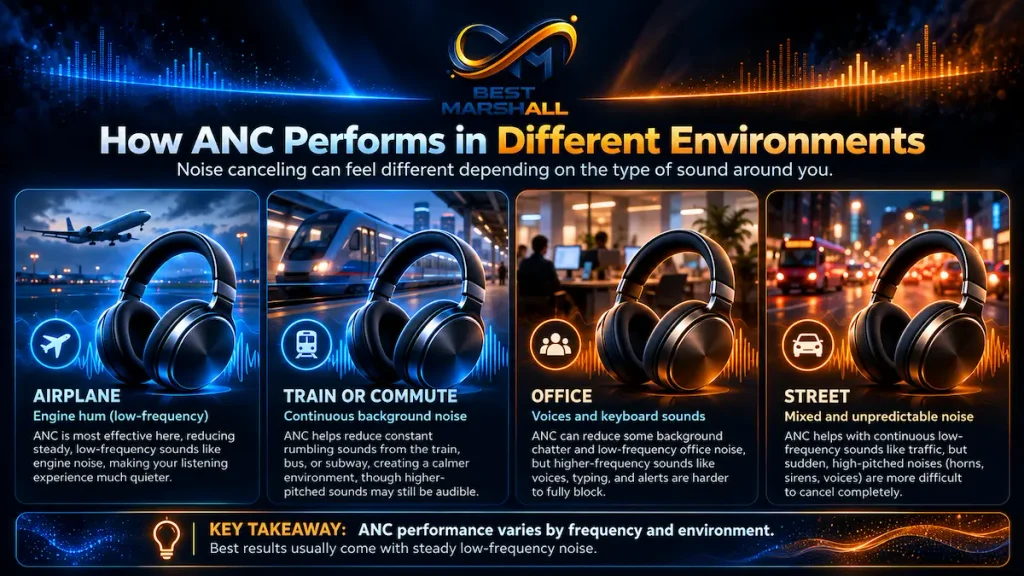
There is no meaningful reason to avoid either model because of ANC.
Sony has a slight advantage in some standardized independent measurements.
Bose remains exceptionally effective and may feel more comfortable or natural to some listeners because of fit and personal perception.
For airplane engines, traffic, office chatter, HVAC noise, and commuting, both perform at a flagship level.
The difference is smaller than the differences in comfort, sound, codecs, calls, and wired connectivity.
Sound Quality
Sound is where the two headphones develop more distinct personalities.
Sony WH-1000XM6 Sound
The Sony uses a 30mm driver and supports:
- SBC;
- AAC;
- LDAC;
- LC3.
LDAC is particularly relevant for compatible Android devices because it supports higher wireless data rates than basic SBC or AAC connections.
Sony also uses DSEE Extreme processing and offers extensive tuning options through the Sony Sound Connect app.
Independent evaluations have been particularly positive about the XM6’s ability to reproduce detail, dynamics, vocals, and instrument separation.
What Hi-Fi praised its combination of detail, spaciousness, musicality, and dynamic performance.
The default tuning is not completely neutral.
RTINGS measured a warm presentation with elevated bass, which gives modern music substantial low-end energy. Users who prefer less bass can adjust the sound through Sony’s app.
Sony’s major strength here is flexibility.
Listeners can shape the XM6 considerably more than many competing premium headphones.
Bose QuietComfort Ultra 2nd Gen Sound
Bose also uses a warm sound profile.
RTINGS measured somewhat elevated bass combined with smoother, less prominent treble.
That can create an easy, full-bodied presentation that works particularly well with pop, hip-hop, electronic music, movies, and casual listening.
Bose’s CustomTune system automatically calibrates sound based partly on how the headphones interact with the listener’s ears.
The Bose app also provides EQ adjustment, although Sony gives users more extensive control.
Independent reviews generally describe Bose sound as enjoyable and refined, but Sony receives more consistent praise for clarity, detail, and dynamic expression.
Sound Quality Verdict
For buyers primarily focused on conventional stereo music reproduction, Sony has the stronger overall case.
Its combination of LDAC, detailed reproduction, dynamic presentation, and deeper customization gives demanding listeners more control.
Bose may be preferable if you enjoy:
- warmer presentation;
- smooth listening;
- prominent low-end weight;
- automatic CustomTune processing;
- immersive/spatial processing.
This is preference-dependent, but Sony’s strengths are particularly compelling for music-focused listeners.
Immersive Audio and Spatial Listening
Bose takes a more aggressive approach to spatial audio.
The QuietComfort Ultra 2nd Gen includes Bose Immersive Audio, which can spatialize audio even when the original content was not mixed specifically for spatial playback.
Bose provides different immersive listening options and also introduced Cinema Mode with the second-generation Ultra.
Cinema Mode is designed to make video content feel more spatial while improving dialogue presentation.
That gives Bose an advantage for users who frequently watch:
- movies;
- TV shows;
- streaming video;
- content on laptops or tablets.
Sony has its own spatial-audio ecosystem and supports technologies such as 360 Reality Audio with compatible content and services.
However, Bose’s ability to apply its immersive processing broadly—and its dedicated Cinema Mode—makes the feature more central to the Bose experience.
Spatial Audio Verdict
Bose has the clearer advantage for users who actively want spatialized movies and entertainment.
For listeners who primarily use conventional stereo music, this advantage becomes less important.
Some professional reviewers also prefer standard stereo listening to Bose’s Immersive Audio for music.
Call Quality and Microphone Performance
This is one of Sony’s strongest advantages.
Sony uses multiple microphones together with beamforming and AI-based voice-isolation processing.
Independent testing has repeatedly praised the WH-1000XM6’s ability to keep voices intelligible while suppressing environmental noise.
What Hi-Fi found call performance particularly strong even around wind and traffic, while RTINGS’ direct comparison also favors Sony for buyers who make frequent calls.
That makes the XM6 especially relevant for:
- remote work;
- phone calls;
- Teams meetings;
- Zoom calls;
- commuting while talking;
- hybrid office environments.
The Bose microphone system is still suitable for normal calls.
RTINGS describes voice capture as reasonably natural and capable of prioritizing speech over environmental noise, although background sounds are not eliminated completely.
Call Quality Verdict
Sony has the advantage.
If you regularly use your headphones as both a music device and a work headset, the XM6’s microphone performance is an important reason to choose it.
Transparency and Awareness Modes
Both products allow environmental sound to pass through when full isolation is inappropriate.
Sony provides Ambient Sound controls and Quick Attention functionality, allowing users to hear surroundings without removing the headphones.
The Sony app also provides considerable control over how the system behaves in different environments.
Bose provides Aware Mode and ActiveSense technology.
ActiveSense is designed to manage sudden loud sounds while allowing users to remain aware of their environment.
Independent assessments generally rate transparency performance highly on both models.
Bose frequently receives praise for creating a natural sense of awareness, while Sony offers more extensive adaptive configuration.
Transparency Verdict
This category is close.
Bose may appeal more to users who want natural, simple environmental awareness.
Sony is better suited to users who want more control over adaptive behavior.
Bluetooth, Codecs, and Wireless Connectivity
Both headphones support Bluetooth multipoint, allowing connection to two devices.
That can be particularly useful for someone who works on a laptop while keeping a smartphone connected.
The codec differences are more important.
Sony WH-1000XM6
Sony supports:
- SBC;
- AAC;
- LDAC;
- LC3.
LDAC remains an important advantage for Android users whose devices support the codec.
LC3 also places the XM6 inside the newer Bluetooth LE Audio ecosystem.
Bose QuietComfort Ultra 2nd Gen
Bose supports:
- SBC;
- AAC;
- aptX Adaptive.
aptX Adaptive is available through compatible Snapdragon Sound-certified devices.
This codec can dynamically adjust characteristics such as audio quality and latency depending on the connection and device.
Codec Verdict
Neither is universally better.
Sony is more attractive for LDAC users and buyers interested in LC3/LE Audio support.
Bose makes more sense for compatible Snapdragon Sound devices using aptX Adaptive.
iPhone users primarily rely on AAC regardless, so codec differences are less significant within Apple’s ecosystem.
Wired Audio: Bose Has a Major Practical Advantage
Both models support analog wired listening.
But the Bose adds something Sony does not:
USB-C digital audio playback.
The QuietComfort Ultra 2nd Gen can play audio directly through USB-C, including lossless digital playback from compatible devices.
That means a laptop, tablet, or phone can deliver audio digitally to the Bose without relying on Bluetooth.
This is useful for:
- laptop listening;
- desk setups;
- flights;
- low-latency video;
- devices without traditional headphone jacks;
- users who want lossless wired digital playback.
Sony’s USB-C connection is used for charging rather than digital audio playback.
For wired audio, Sony relies on its analog headphone cable.
Wired Connectivity Verdict
Bose clearly wins for USB-C flexibility.
For buyers who regularly connect premium headphones to a laptop or USB-C device, this can be more important than small differences in Bluetooth performance.
Battery Life
On manufacturer specifications, the two appear similar.
Sony rates the WH-1000XM6 for:
- up to 30 hours with noise cancellation enabled;
- up to 40 hours with noise cancellation disabled.
Bose rates the QuietComfort Ultra 2nd Gen for:
- up to 30 hours of standard listening;
- up to 23 hours with Immersive Audio enabled.
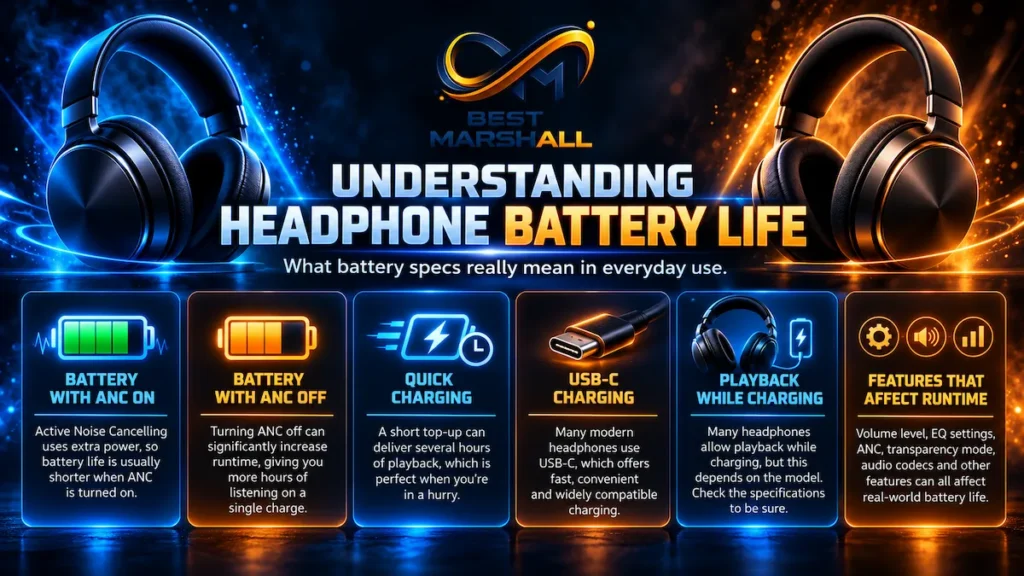
Battery performance varies according to volume, codecs, ANC behavior, calls, temperature, and other features.
Independent testing adds some context.
RTINGS measured approximately 31.75 hours of continuous playback from the Sony under its standardized methodology, while its Bose test substantially exceeded Bose’s own 30-hour rating.
Those measurements should not be treated as guarantees because testing conditions differ from individual use.
The more important distinction is that Sony explicitly offers significantly longer rated runtime when ANC is disabled.
Battery Verdict
With typical ANC use, the two are competitive.
Sony has the stronger manufacturer-rated maximum when ANC is switched off.
Bose has performed particularly well in some independent continuous-playback testing.
Immersive Audio reduces Bose battery life noticeably, so frequent use of that feature changes the comparison.
App and Customization
The Sony Sound Connect app is one of the strongest software platforms in this category.
It provides extensive control over:
- EQ;
- ANC behavior;
- ambient sound;
- adaptive sound settings;
- connected devices;
- listening features;
- codec-related settings;
- personalization.
For users who enjoy adjusting their headphones, Sony provides more depth.
The Bose app is simpler.
It provides:
- EQ adjustment;
- listening modes;
- Immersive Audio;
- Cinema Mode;
- ANC configuration;
- Bluetooth device management;
- shortcut customization;
- firmware updates.
Bose’s approach is easier to understand but provides fewer deep sound-tuning controls.
App Verdict
Sony wins for customization.
Bose may be preferable for users who want fewer settings and a simpler interface.
Controls
Sony combines touch controls with physical controls.
The touch surface provides access to common playback and volume functions, while Quick Attention lets users temporarily hear their environment through a simple gesture.
RTINGS describes Sony’s touch-control implementation as more comprehensive than Bose’s.
Bose combines physical buttons with a capacitive volume slider.
Some users like the simplified design, while recurring public feedback indicates that the volume slider can occasionally feel overly sensitive or lead to accidental adjustments.
This is fundamentally a preference issue.
Controls Verdict
Sony provides more comprehensive controls.
Bose offers a simpler layout but its volume slider may not appeal to everyone.
What Customer Feedback Suggests
Publicly available feedback for both headphones is predominantly positive, particularly around sound, comfort, battery life, and noise cancellation.
Best Marshall does not use Amazon star ratings or Amazon review-count data in this comparison.
Sony WH-1000XM6 Feedback
Commonly praised areas include:
Sound quality:
Users frequently highlight clarity, bass performance, detail, and overall musical performance.
Comfort:
The lightweight design receives substantial positive feedback, particularly for extended listening.
Battery life:
Long runtime is another recurring strength.
Portability:
Owners often appreciate the return of a folding design.
Connectivity:
Multipoint and app integration are generally viewed positively.
Recurring concerns include:
Ear warmth:
Some users report that the earcups can become warm during extended listening.
Maximum volume:
A smaller group of users would prefer greater maximum output.
Hinge durability concerns:
There are individual reports of hinge-related failures, although public feedback is mixed and there is not enough evidence to characterize the issue as universal or inevitable.
Bose QuietComfort Ultra 2nd Gen Feedback
Commonly praised areas include:
Comfort:
This is one of the most consistent strengths in user feedback.
Sound quality:
Users generally describe the sound as rich and satisfying.
Noise cancellation:
ANC is frequently cited as one of the main reasons for choosing Bose.
Battery life:
Real-world user reports are generally favorable.
Lightweight fit:
Despite weighing slightly more than Sony on paper, many users find the Bose particularly easy to wear for extended periods.
Recurring concerns include:
Touch-sensitive volume control:
Some owners find the slider too sensitive or less intuitive than conventional buttons.
Heat during long sessions:
A small number of users report heat buildup around the earcups.
Fit differences:
Although comfort is broadly praised, fit remains individual and some users report that the earcup geometry or seal does not suit them.
Taken together, the customer-feedback patterns support the broader comparison: Sony’s appeal centers strongly around audio performance, customization, portability, and calls, while Bose receives particularly consistent praise for comfort and ANC.
Sony WH-1000XM6 Pros and Cons
Pros
- Exceptional active noise cancellation
- Detailed and dynamic sound reproduction
- LDAC and LC3 codec support
- Strong microphone and call quality
- Extensive app customization
- Lightweight design
- Foldable for travel
- Up to 40 hours of rated playback with ANC off
- Bluetooth multipoint
- Strong adaptive ambient-sound features
Cons
- No USB-C digital audio playback
- Some users report heat buildup during long sessions
- Long-term hinge feedback includes some durability concerns
- Premium pricing
Bose QuietComfort Ultra Headphones 2nd Gen Pros and Cons
Pros
- Exceptional noise cancellation
- Excellent long-session comfort
- Deep, accommodating earcups
- USB-C digital and lossless audio playback
- aptX Adaptive with compatible Snapdragon Sound devices
- Bose Immersive Audio
- Dedicated Cinema Mode
- Bluetooth multipoint
- Strong battery performance
- Foldable travel-friendly design
Cons
- Less extensive EQ and customization than Sony
- Immersive Audio reduces rated battery life
- Volume slider receives mixed user feedback
- Premium pricing
Value for Money: Bose QuietComfort vs Sony WH-1000XM6
These headphones compete in essentially the same flagship price category.
At the time of research, Sony’s official U.S. manufacturer pricing sat slightly above Bose’s official pricing, but the difference was relatively small compared with the overall cost of either product.
Amazon pricing can change frequently, so current listings should be checked before making a purchase decision.
Value therefore depends less on which product costs a few dollars less and more on whether you will actually use its distinctive features.
Sony Offers Better Value If You Need:
- stronger call performance;
- LDAC;
- LC3;
- extensive EQ control;
- more advanced personalization;
- highly detailed music reproduction;
- up to 40 hours of rated battery life without ANC.
Someone using Android with LDAC, taking frequent work calls, and adjusting EQ carefully may receive more practical value from the Sony even if it costs slightly more.
Bose Offers Better Value If You Need:
- maximum comfort;
- USB-C digital audio;
- aptX Adaptive;
- Cinema Mode;
- Immersive Audio;
- simpler controls and app configuration;
- deeper earcup accommodation.
Someone who flies frequently, wears headphones for many consecutive hours, and connects to a laptop through USB-C may benefit much more from Bose’s specific strengths.
What If You Only Want Great ANC?
Then value becomes more difficult to separate.
Both deliver genuinely high-end noise cancellation.
Choosing purely on ANC may therefore be less useful than considering comfort, calls, sound preferences, codecs, and wired connectivity.
Final Verdict: Which One Should You Buy?
The Bose QuietComfort vs Sony WH-1000XM6 comparison does not produce a universal winner.
Both are flagship noise-canceling headphones, and both perform strongly enough in their core function that buyer priorities should determine the decision.
Choose the Sony WH-1000XM6 If:
- music quality is one of your highest priorities;
- you want extensive EQ and personalization;
- you make frequent phone or video calls;
- you use LDAC on Android;
- LC3 and LE Audio support matter;
- you prefer a slightly lighter headphone;
- you want up to 40 hours of rated battery life with ANC disabled;
- USB-C audio is not important.
Choose the Bose QuietComfort Ultra Headphones 2nd Gen If:
- long-term comfort is your highest priority;
- you have larger ears or are sensitive to shallow earcups;
- you want USB-C digital audio;
- you use a compatible Snapdragon Sound device;
- Bose Immersive Audio appeals to you;
- you frequently watch movies or video and would use Cinema Mode;
- you prefer a simpler app experience;
- you spend long periods traveling with ANC enabled.
Best Marshall’s Conclusion
For music, calls, codec flexibility, and customization, the Sony WH-1000XM6 has the stronger overall package.
Its combination of detailed sound, excellent microphones, LDAC, LC3, advanced ANC processing, and deep software controls makes it particularly versatile for users who want to customize how their headphones behave.
For comfort, USB-C listening, and immersive entertainment, the Bose QuietComfort Ultra Headphones (2nd Gen) has meaningful advantages.
Its spacious earcups, consistently praised comfort, USB-C digital audio, aptX Adaptive support, and Cinema Mode make it especially compelling for long flights, extended work sessions, and movie watching.
Noise cancellation alone should probably not determine the purchase. Independent evidence places both at the top of the category, with relatively small differences compared with the much clearer contrasts in sound, calls, comfort, codecs, and connectivity.
Ultimately, the better choice depends on which strengths matter most for the way you actually listen.
Check Current Price and Availability on Amazon
Sony WH-1000XM6
Check Current Price on Amazon
Bose QuietComfort Ultra Headphones (2nd Gen)
Check Current Price on Amazon
Bose QuietComfort Ultra Bluetooth Headphones 2nd
Amazon pricing, seller availability, colors, bundle contents, and promotions can change. Verify that the listing corresponds to the exact model and generation before purchasing.