Choosing a power bank by capacity seems simple: more milliamp-hours should mean more charging.
Technically, it is not that simple.
A 10,000mAh portable charger does not deliver 10,000mAh directly into your phone battery. A 20,000mAh model does not necessarily recharge a 5,000mAh smartphone four times. And a high-capacity battery pack may still be a poor choice for a laptop if its USB-C output cannot provide enough wattage.
The reason is that mAh measures electrical charge, while the energy available to charge another device depends on voltage, conversion efficiency, cable losses, charging electronics, temperature, and the battery inside the device being charged.
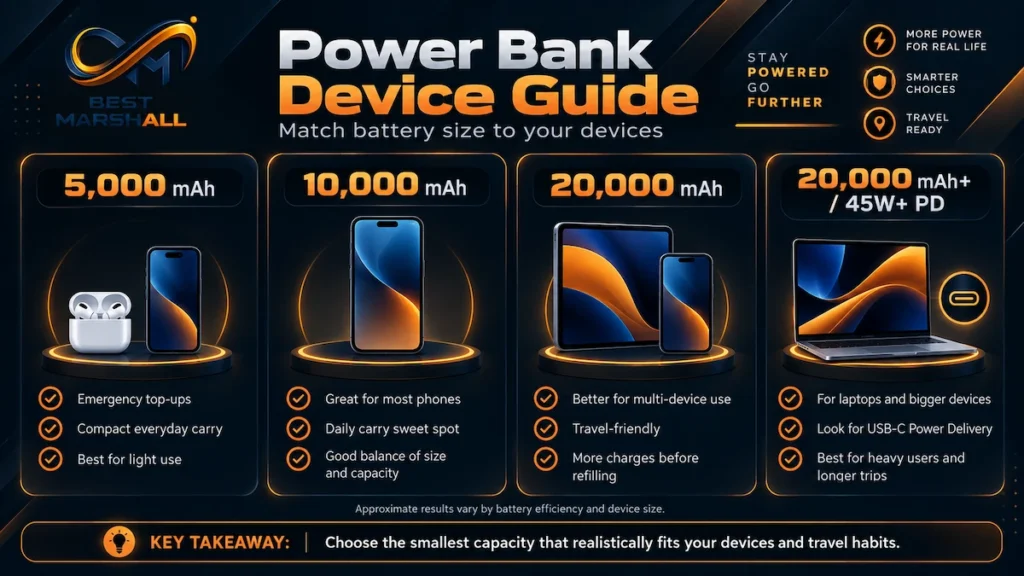
For most smartphone users, 10,000mAh is the practical sweet spot between size and usable energy. A 5,000mAh model is better for emergency top-ups and minimum weight. Around 20,000mAh makes more sense for travel, tablets, multiple devices, and heavy use. For laptop charging, capacity in watt-hours and USB-C Power Delivery output become more useful than mAh alone.
This guide explains how power bank capacity actually works, how to estimate real-world charges, what size makes sense for different devices, and why watt-hours, output wattage, USB Power Delivery, safety standards, and airline rules matter just as much as the number printed on the battery.
Quick Answer: How Many mAh Do You Need in a Power Bank?
For most users:
| Power Bank Capacity | Best Use | Practical Expectation |
|---|---|---|
| 5,000mAh | Emergency backup, short days, magnetic phone packs | Usually a partial to roughly one full smartphone charge |
| 10,000mAh | Everyday carry, commuting, most travelers | Roughly 1–2 smartphone charges |
| 15,000mAh | Heavy phone use without 20,000mAh bulk | Useful middle ground |
| 20,000mAh | Trips, tablets, multiple devices, heavy use | Roughly 2–4 smartphone charges |
| 25,000–27,000mAh | Laptop users, long trips, multiple devices | Near the practical upper range for many air travelers |
| 30,000mAh+ | Specialized high-capacity use | Heavier and may exceed standard airline limits |
These are estimates, not guarantees.
The actual number of charges depends on watt-hours, conversion efficiency, device battery size, charging method, temperature, and whether the device is being used while charging.
What Does mAh Actually Mean?
mAh stands for milliampere-hour.
Technically, it measures electric charge.
A battery rated at 10,000mAh could theoretically supply:
- 10,000mA for one hour;
- 5,000mA for two hours;
- 1,000mA for ten hours;
under idealized conditions at the battery’s rated voltage.
But this number does not tell you the complete amount of energy stored.
To understand energy, voltage must also be considered.
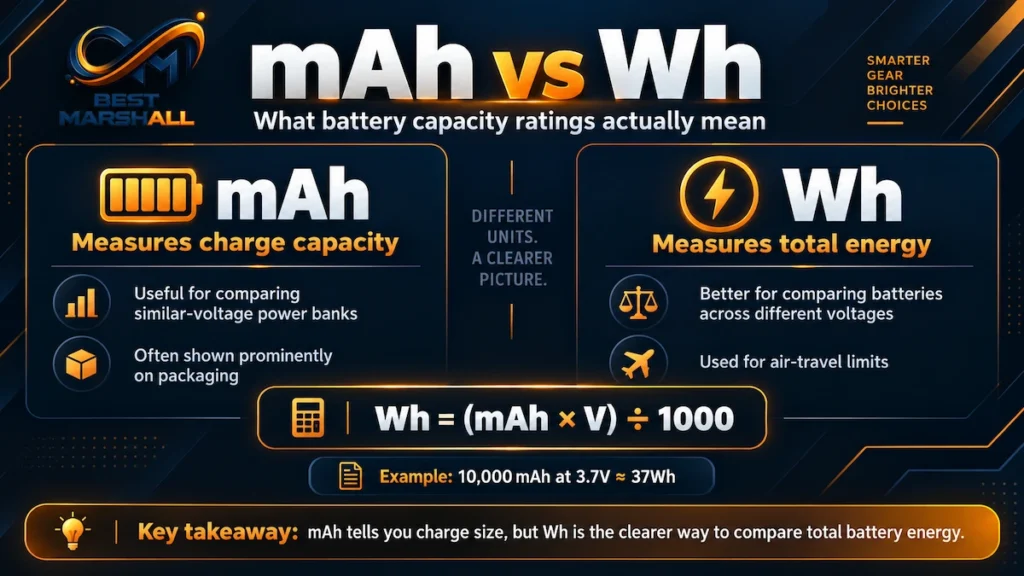
That is why watt-hours are often more useful when comparing different batteries.
The relationship is:
Watt-hours = Amp-hours × Voltage
Or, when starting with mAh:
Wh = (mAh ÷ 1,000) × nominal battery voltage
A 10,000mAh power bank using cells with a nominal voltage of 3.7V therefore stores approximately:
10 × 3.7 = 37Wh
A 20,000mAh model at the same nominal voltage stores approximately:
20 × 3.7 = 74Wh
This is the first important lesson:
mAh tells you charge capacity at a particular voltage. Wh tells you stored energy.
Why a 10,000mAh Power Bank Does Not Deliver 10,000mAh to Your Phone
This is one of the most misunderstood specifications in portable charging.
The advertised capacity usually describes the power bank’s internal cells at their nominal voltage, often around 3.6–3.7V.
USB output commonly operates at:
- 5V;
- 9V;
- 12V;
- 15V;
- 20V;
- or other negotiated voltages in advanced USB Power Delivery systems.
Voltage therefore has to be converted.
Conversion is not lossless.
Energy is lost through:
- voltage conversion;
- internal circuitry;
- cable resistance;
- connector resistance;
- heat;
- the receiving device’s charging electronics;
- battery chemistry.
A 10,000mAh Example
Assume a power bank contains:
10,000mAh at 3.7V
Its stored energy is:
10Ah × 3.7V = 37Wh
If that energy were converted to 5V with perfect efficiency:
37Wh ÷ 5V = 7.4Ah
or:
7,400mAh
So even before conversion losses, the equivalent capacity at 5V is already below the advertised 10,000mAh.
Now add conversion losses.
Well-designed power-bank electronics can often convert energy with efficiency in roughly the 80–90% range under favorable conditions, although performance varies with voltage, load, temperature, design, and operating mode.
At 85% conversion efficiency:
37Wh × 0.85 = 31.45Wh
That equals approximately:
31.45Wh ÷ 5V = 6,290mAh at 5V
And the phone itself still has its own charging losses before all of that energy reaches the battery cells.
This is why dividing a power bank’s advertised mAh by your phone’s mAh produces an overly optimistic answer.
The Better Way to Calculate How Many Charges You Will Get
For accurate comparisons, use watt-hours rather than mAh whenever possible.
A useful approximation is:
Estimated full charges = power bank Wh × overall usable efficiency ÷ device battery Wh
Example: 10,000mAh Power Bank and a 5,000mAh Phone
Assume:
- power bank: 10,000mAh at 3.7V;
- stored energy: 37Wh;
- phone battery: 5,000mAh at approximately 3.85V;
- phone battery energy: approximately 19.25Wh.
If approximately 70% of the original stored energy ultimately reaches the phone battery after the complete conversion and charging process:
37Wh × 0.70 = 25.9Wh usable
Then:
25.9Wh ÷ 19.25Wh = approximately 1.35 full charges
The precise result will vary, but this calculation explains why the real number may be closer to one and a half charges than two.
Why You Should Not Directly Divide mAh by mAh
Consider this calculation:
10,000mAh power bank ÷ 5,000mAh phone = 2 charges
It looks reasonable.
It is also incomplete.
The two mAh ratings may be specified at different nominal voltages, and energy is lost during transfer.
Comparing battery capacity only in mAh is therefore most meaningful when the batteries operate at the same nominal voltage.
For cross-device comparisons, Wh provides the cleaner technical reference.
How Much Usable Capacity Does a Power Bank Really Have?
There is no universal percentage that applies to every model.
Efficiency changes with:
- cell chemistry;
- battery condition;
- charging voltage;
- output power;
- converter quality;
- cable resistance;
- ambient temperature;
- wireless vs. wired charging;
- device charging circuitry.
A manufacturer may also distinguish between:
Cell capacity: the capacity of the internal battery cells.
Rated output capacity: the amount expected after voltage conversion under specified test conditions.
These are not necessarily the same number.
As a practical rule, never assume the entire advertised mAh rating reaches the connected device.
If precise energy requirements matter, look for:
- rated capacity;
- Wh rating;
- output efficiency documentation;
- actual output test data from credible independent evaluations.
Is 5,000mAh Enough?
A 5,000mAh power bank is primarily a portability solution.
At a nominal 3.7V, it stores approximately:
18.5Wh
After conversion and charging losses, that is generally not enough to guarantee a complete recharge of every modern large-battery smartphone.
It can still be very useful.
5,000mAh Makes Sense If You:
- mainly need emergency power;
- recharge your phone before it reaches 0%;
- commute for part of the day;
- prioritize minimal weight;
- use a compact magnetic battery pack;
- rarely charge multiple devices.
Its Main Limitation
A small pack has limited reserve.
If your phone battery is large, heavily depleted, or being used continuously for:
- navigation;
- video recording;
- gaming;
- hotspot operation;
- high-brightness display use;
a 5,000mAh pack may function more like an extended runtime battery than a complete recharge system.
Is 10,000mAh Enough?
For most smartphone users, 10,000mAh is the most practical general-purpose capacity.
See example: INIU 10,000mAh
It stores around 37Wh when based on 3.7V cells and usually provides enough usable energy for approximately one to two smartphone recharges, depending on the phone.
The important advantage is balance.
A 10,000mAh pack can still fit into:
- backpacks;
- purses;
- travel bags;
- jacket pockets;
- some pants pockets.
At the same time, it provides substantially more reserve than 5,000mAh.
10,000mAh Is Particularly Well Suited To:
- daily commuting;
- full-day events;
- tourism;
- smartphone photography;
- navigation-heavy travel;
- theme parks;
- business travel;
- emergency preparedness.
For someone who primarily wants to keep one smartphone alive through a long day, moving immediately to 20,000mAh may add more weight than useful capacity.
When Does 15,000mAh Make Sense?
The 15,000mAh category is less common than 10,000 or 20,000mAh but can provide a useful compromise.
At 3.7V:
15,000mAh ≈ 55.5Wh
It offers more reserve than a standard everyday pack without reaching the size and weight of many 20,000mAh models.
It can make sense for:
- heavy smartphone users;
- weekend trips;
- a phone plus earbuds or smartwatch;
- users who regularly exhaust 10,000mAh but dislike large battery packs.
The disadvantage is market selection: fewer products occupy this middle tier, so choosing by capacity alone may mean sacrificing charging speed, design, or value compared with established 10,000 and 20,000mAh options.
Who Needs a 20,000mAh Power Bank?
A 20,000mAh power bank moves from everyday backup toward multi-device and multi-day use.
At a 3.7V nominal cell voltage:
20,000mAh ≈ 74Wh
That is enough stored energy to support considerably more demanding workflows.
See example: INIU 20,000mAh
20,000mAh Makes Sense For:
- multiple-day trips;
- two people sharing one battery;
- phone plus tablet;
- cameras and creator accessories;
- handheld gaming devices;
- extended navigation;
- camping with periodic device charging;
- some USB-C laptops.
The trade-off is straightforward:
more capacity means more battery cells, which usually means more mass and volume.
A 20,000mAh model is far less likely to disappear comfortably into a pants pocket.
For a backpack, however, it can be an excellent travel capacity.
Do You Need 25,000 to 27,000mAh?
This range becomes particularly interesting for laptop charging and extended travel.
At 3.7V:
25,000mAh ≈ 92.5Wh
and:
27,000mAh ≈ 99.9Wh
That puts 27,000mAh very close to the important 100Wh aviation threshold.
This is not accidental.
Many high-capacity travel-oriented power banks are designed close to 100Wh because it provides substantial energy while remaining within the standard aviation limit used in many jurisdictions.
But never determine airline compliance from mAh alone.
Always check the Wh rating printed on the actual power bank.
Different products may use different nominal cell voltages.
Should You Buy a 30,000mAh Power Bank?
A 30,000mAh unit can be useful for high-energy applications, but it introduces new trade-offs.
At a 3.7V nominal voltage:
30,000mAh ≈ 111Wh
That exceeds the standard 100Wh threshold applied to lithium-ion batteries on many passenger flights.
A battery in the 101–160Wh range may require carrier approval under U.S. FAA rules, while airline and international rules can be stricter.
A 30,000mAh pack is also heavier.
It makes more sense for:
- road travel;
- remote work away from outlets;
- multiple devices;
- field equipment;
- high-capacity emergency use;
than as a routine pocket charger.
For air travelers, approximately 20,000–27,000mAh is often the more practical ceiling, subject to the actual Wh rating and airline policy.
mAh vs. Watts: Capacity Is Not Charging Speed
A common buying mistake is assuming that a higher-capacity battery charges devices faster.
It does not necessarily.
mAh describes capacity. Watts describe power delivery.
Power is:
Watts = Volts × Amps
Consider two hypothetical products:
- Power Bank A: 20,000mAh, maximum 18W output
- Power Bank B: 10,000mAh, maximum 65W USB-C output
Power Bank A stores more energy.
Power Bank B can potentially charge a compatible device much faster.
This distinction becomes critical for:
- tablets;
- handheld gaming systems;
- laptops.
How Much Output Power Do You Need?
The answer depends on the connected device.
General categories look like this:
Phones
Many smartphones can benefit from roughly 20–45W charging systems, depending on model and protocol.
Buying a 100W power bank will not force 100W into the phone.
With standards such as USB Power Delivery, the source and device negotiate an appropriate charging level.
Tablets
Larger tablets can benefit from higher USB-C output, especially when being used while charging.
Laptops
Laptop charging frequently requires approximately 45W, 65W, 100W, or more depending on the computer.
A power bank may contain enough energy to recharge a laptop but still lack enough power to charge it effectively.
For example, a 74Wh pack with only 20W output may technically store substantial energy but may be inappropriate for a laptop designed around a 65W charger.
USB Power Delivery Explained
USB Power Delivery, or USB PD, is a power-negotiation standard that allows compatible USB-C devices and chargers to communicate and select appropriate voltage and current levels.
The USB Implementers Forum currently defines USB Power Delivery capabilities reaching as high as 240W through USB-C under the Extended Power Range architecture.
That does not mean every USB-C power bank supports 240W.
The actual charging rate is limited by the weakest part of the system:
- power bank;
- individual output port;
- cable;
- connected device;
- negotiated charging protocol.
A laptop capable of 100W charging connected to a 45W power bank can receive no more than the system can successfully negotiate.
What Is PPS?
Programmable Power Supply, or PPS, is an optional feature within USB Power Delivery that allows a compatible device to request more finely adjusted voltage and current levels.
Instead of relying only on fixed voltage steps, PPS allows dynamic adjustment.
Potential benefits include:
- more efficient fast charging;
- reduced unnecessary voltage conversion;
- improved thermal management;
- better compatibility with some fast-charging smartphones.
PPS matters only when both the power bank and device support it.
A PPS label therefore does not automatically make a battery faster for every phone.
Does the USB-C Cable Matter?
Yes.
USB-C describes a connector, not a single power capability.
Current USB-IF requirements distinguish USB-C cables by supported power levels, including 60W and 240W markings in compliant certification programs.
Using an inadequate cable can limit charging performance even when both the power bank and device support higher power.
For higher-power laptop charging, verify:
- cable power rating;
- USB Power Delivery compatibility;
- required electronic marking where applicable;
- cable condition.
A premium 100W or 140W power bank cannot deliver its maximum capability through every USB-C cable ever made.
What Does “100W Power Bank” Actually Mean?
Read the specification carefully.
A product advertised as 100W may mean:
- one USB-C port can deliver 100W;
- all ports combined can deliver 100W;
- the power bank accepts 100W input;
- both input and output support 100W;
- maximum output occurs only when one device is connected.
These are different specifications.
Look for:
- maximum single-port output;
- total combined output;
- power distribution with two devices;
- power distribution with three devices;
- maximum input wattage.
This becomes especially important when simultaneously charging a laptop, phone, and another accessory.
Input Power Matters Too
Power banks also need to recharge themselves.
A large 20,000 or 25,000mAh battery with slow input can require many hours to refill.
High-capacity users should therefore examine both:
Output power: how fast the power bank can charge devices.
Input power: how fast the power bank itself can recharge.
A high USB-C PD input can substantially reduce turnaround time when paired with a compatible charger.
How Much Capacity Do You Need for a Laptop?
For laptops, stop thinking primarily in mAh.
Use Wh.
Assume a laptop contains a 60Wh battery.
A 20,000mAh power bank at 3.7V contains:
74Wh
That does not mean it provides 1.23 complete charges.
After conversion losses, perhaps only around 55–60Wh may reach the laptop’s charging system under a representative efficient wired scenario.
That could approach one full equivalent charge for a 60Wh laptop, but the result varies significantly.
Now consider a 25,000mAh pack:
25Ah × 3.7V = 92.5Wh
After conversion loss, it offers substantially more usable laptop energy.
Laptop Buyers Should Check Three Things
- Power bank Wh capacity
- USB-C output wattage
- Laptop charging requirement
A huge battery with insufficient output wattage is not a good laptop charger.
A very powerful 100W output on a tiny battery may charge quickly but provide limited runtime.
You need both capacity and power.
Does Wireless Charging Change How Much Capacity You Need?
Yes.
Wireless charging generally introduces additional energy loss compared with a good wired connection because power must cross an air gap through electromagnetic induction.
Alignment matters.
Heat matters.
Distance between charging coils matters.
Cases and accessories can also affect efficiency.
As a result, a 10,000mAh wireless power bank will generally provide fewer equivalent phone recharges when used wirelessly than when using an efficient wired USB-C connection.
Qi2 and Qi2 25W Explained
The Wireless Power Consortium’s Qi2 standard introduced magnetic alignment and certified interoperable wireless charging at up to 15W for its original Magnetic Power Profile.
The newer Qi2 25W generation increases certified wireless charging power to as much as 25W for compatible equipment.
Magnetic alignment helps position the transmitter and receiver coils correctly, which can improve consistency and efficiency.
But buyers should distinguish:
- “magnetic”;
- “Qi compatible”;
- “Qi2 Certified”;
- “Qi2 25W Certified.”
They are not automatically interchangeable claims.
If wireless charging interoperability matters, verify certification rather than relying only on marketing language.
Power Bank Capacity Guide by User Type
Light User
Choose approximately:
5,000mAh
Appropriate if you:
- normally finish the day with battery remaining;
- need occasional emergency charging;
- want minimum weight.
Typical Smartphone User
Choose approximately:
10,000mAh
This is the strongest general-purpose capacity for most people.
It balances:
- portability;
- reserve energy;
- cost;
- physical size.
Heavy Smartphone User or Weekend Traveler
Consider:
10,000–15,000mAh
Useful when:
- navigation is frequent;
- cellular coverage is weak;
- photography/video use is high;
- you spend long periods away from outlets.
Multi-Device or Multi-Day Traveler
Choose approximately:
20,000mAh
Useful for:
- phone + tablet;
- two phones;
- handheld gaming;
- creator accessories;
- longer travel.
Laptop User
Consider:
20,000–27,000mAh, with sufficient USB-C PD output.
Capacity alone is not enough.
Verify the required wattage.
Maximum-Capacity User
Above approximately:
27,000mAh
can make sense for specialized uses, but weight and aviation restrictions become increasingly important.
Power Banks and Air Travel: Why Wh Matters More Than mAh
Airline battery rules are based primarily on watt-hours.
For U.S. aviation, the Federal Aviation Administration currently states:
- 0–100Wh: generally allowed on passenger aircraft;
- 101–160Wh: airline approval required, with additional restrictions;
- over 160Wh: prohibited for ordinary passenger-carried power banks.
Power banks are treated as spare lithium-ion batteries and must remain in carry-on baggage, not checked luggage.
How to Convert mAh to Wh for Air Travel
Use:
Wh = mAh ÷ 1,000 × nominal voltage
At 3.7V:
| Capacity | Approximate Energy |
|---|---|
| 5,000mAh | 18.5Wh |
| 10,000mAh | 37Wh |
| 15,000mAh | 55.5Wh |
| 20,000mAh | 74Wh |
| 25,000mAh | 92.5Wh |
| 26,800mAh | 99.2Wh |
| 27,000mAh | 99.9Wh |
| 30,000mAh | 111Wh |
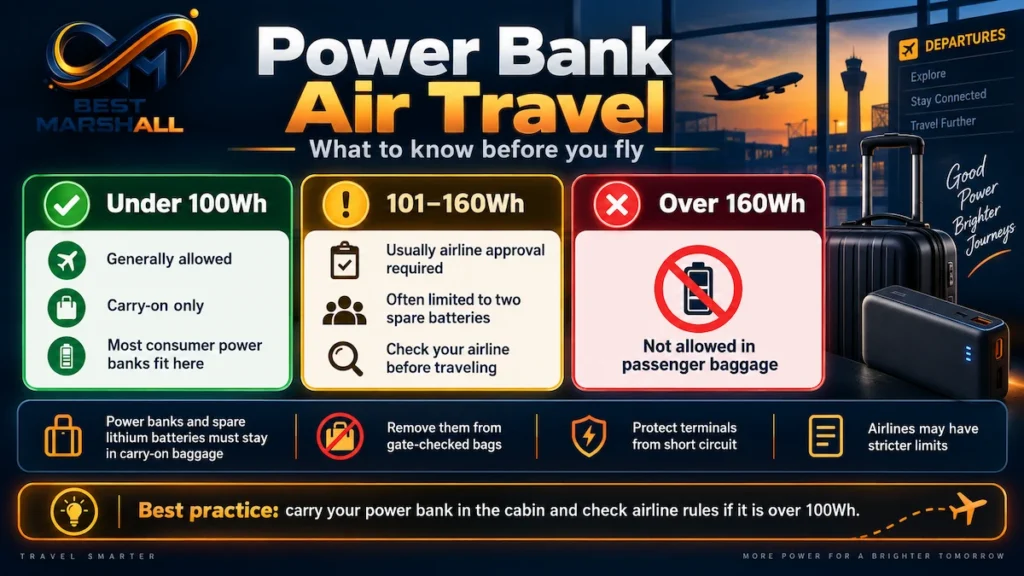
These figures are illustrative.
Use the Wh rating printed by the manufacturer when determining travel compliance.
Important 2026 International Rule Changes
International aviation guidance became more restrictive in 2026.
IATA guidance following changes from the International Civil Aviation Organization specifies additional measures for power banks, including a maximum of two power banks per passenger under the updated framework and restrictions on charging power banks while onboard.
Airlines may impose still stricter rules.
There is also an important regulatory nuance: current U.S. FAA passenger guidance continues to state that personal-use rechargeable batteries below 100Wh do not have the same general numeric quantity limit, while international and individual airline policies may be more restrictive.
Therefore:
Never assume a power bank is flight-compliant solely because it is below 100Wh. Check the specific airline’s current rules before travel.
Can You Put a Power Bank in Checked Luggage?
No under standard U.S. aviation rules.
The FAA requires spare lithium batteries—including power banks and portable chargers—to remain in the aircraft cabin.
If a carry-on bag is unexpectedly gate-checked, remove the power bank before the bag goes into the hold.
The reason is safety.
Lithium-ion batteries can enter thermal runaway, a failure condition in which heat generation accelerates and can lead to fire.
A battery incident in the passenger cabin can be detected and addressed by trained crew more rapidly than an incident inside a cargo compartment.
Why Power Bank Safety Matters
Capacity and wattage are not the only specifications worth researching.
Lithium-ion battery packs combine:
- energy-dense cells;
- charging electronics;
- power-conversion circuitry;
- thermal management;
- protective circuitry.
Failures can involve:
- overheating;
- swelling;
- smoke;
- fire;
- thermal runaway.
The U.S. Consumer Product Safety Commission has continued issuing power-bank recalls involving overheating and fire hazards, including multiple recalls in 2025 and 2026.
That does not mean power banks are inherently unsafe.
It means safety engineering and product traceability matter.
What Is UL 2056?
UL 2056 is a dedicated safety standard for power banks.
The current U.S. standard covers qualifying standalone power banks up to 100Wh and is intended to reduce risks including fire and explosion.
When comparing products, look for credible safety certification or listing information rather than vague statements such as:
- “100% safe”;
- “military-grade protection”;
- “ultimate safety technology.”
Marketing terminology is not a substitute for recognized testing.
Certification to relevant standards does not make battery failure impossible, but it provides stronger evidence that the product has undergone defined safety evaluation.
Check for Product Recalls
Before relying heavily on a power bank—especially an older unit—check whether the exact model has been recalled.
Model number matters.
A recall often applies to a specific:
- product revision;
- manufacturing batch;
- serial-number range;
- production period.
Do not assume an entire brand is unsafe because one model was recalled, and do not assume every model from a familiar brand is automatically unaffected.
For U.S. consumers, CPSC recall information is the authoritative place to verify current recall status.
Stop Using a Power Bank If It Is Damaged
Do not continue using a lithium-ion power bank that shows signs such as:
- swelling;
- unusual deformation;
- cracking;
- leakage;
- unusual odor;
- excessive unexplained heat;
- smoke;
- fire damage;
- significant water damage.
Damaged or recalled lithium batteries may also be prohibited from passenger aircraft.
Do not puncture or crush a swollen battery.
Follow local hazardous-battery disposal requirements rather than placing a damaged lithium battery into ordinary household trash.
Common Beginner Mistakes When Choosing Power Bank Capacity
Mistake 1: Dividing Power Bank mAh by Phone mAh
This ignores voltage and conversion losses.
Use Wh for a more accurate energy comparison.
Mistake 2: Buying the Highest mAh Available
A huge battery is unnecessary if it remains at home because it is too heavy to carry.
The best capacity is the smallest one that reliably meets your actual energy requirement.
Mistake 3: Ignoring Charging Wattage
A 25,000mAh pack with insufficient output may be worse for a laptop than a smaller model with proper USB-C PD support.
Mistake 4: Confusing USB-C With Fast Charging
USB-C is a connector format.
It does not guarantee:
- USB PD;
- PPS;
- 65W;
- 100W;
- 140W;
- any other particular charging rate.
Read the specifications.
Mistake 5: Ignoring Per-Port Power
A “100W” multi-port power bank may divide that power when several devices are connected.
Read the power-distribution table.
Mistake 6: Forgetting Recharge Speed
A massive battery with slow input can be frustrating to recharge.
Input wattage matters.
Mistake 7: Assuming Wireless and Wired Charging Use the Same Amount of Energy
Wireless transfer typically incurs additional loss.
Expect fewer equivalent charges when relying heavily on wireless charging.
Mistake 8: Buying a 30,000mAh Pack for Air Travel Without Checking Wh
It may exceed 100Wh.
Capacity in mAh alone does not determine compliance.
Mistake 9: Ignoring Safety Certification and Recall History
Lithium-ion power banks store substantial energy.
Model-specific safety information matters.
Mistake 10: Assuming More Watts Can Damage a Phone
A properly implemented negotiated charging system does not simply force the charger’s maximum wattage into a device.
Compatible USB PD equipment negotiates the power the receiving device can accept.
How to Choose the Right Power Bank: Technical Checklist
Before buying, check the following.
Capacity
Ask:
- How many devices do you charge?
- How large are their batteries?
- How many full charges do you actually need?
- Will you carry the pack every day?
Energy
Look for the Wh rating, particularly for:
- laptops;
- travel;
- cross-device capacity comparisons.
Single-Port Output
Confirm that one port can provide enough watts for your most demanding device.
Total Output
If charging multiple devices, check how power is distributed simultaneously.
Charging Protocols
Depending on your devices, look for appropriate support such as:
- USB Power Delivery;
- PPS;
- Qi2;
- Qi2 25W;
- device-specific compatible fast-charging protocols.
Input Power
High-capacity packs benefit from faster USB-C input.
Cable Capability
Use a cable rated for the required power.
Safety
Look for:
- recognized certification or listing;
- documented battery protections;
- traceable model information;
- current recall status.
Air Travel
Check:
- printed Wh rating;
- airline rules;
- destination rules;
- current carry-on restrictions.
What Capacity Offers the Best Value?
The largest power bank does not automatically provide the best value.
A useful value calculation includes:
capacity + output power + input power + portability + safety + compatibility
For many smartphone users, 10,000mAh offers the strongest balance because adding capacity beyond that increasingly adds weight.
For users who routinely carry a backpack, 20,000mAh often becomes more practical.
Laptop users may benefit from 20,000–27,000mAh, but only if the power electronics provide sufficient USB-C output.
The ideal capacity therefore depends on usable energy per amount of weight you are willing to carry.
Technical FAQ
How many mAh should a good power bank have?
For most smartphone users, around 10,000mAh provides the best balance between capacity and portability. Heavy users and travelers may benefit from 20,000mAh.
Is 5,000mAh enough for a power bank?
Yes for emergency and light use. It may provide approximately a partial to one full modern smartphone charge depending on the phone and charging efficiency.
Is 10,000mAh enough for a full day?
For most users, yes. It typically provides enough energy for one or more meaningful smartphone recharges while remaining reasonably portable.
How many times can a 10,000mAh power bank charge a phone?
Usually around one to two times, but the exact number depends on the phone battery’s Wh rating and charging efficiency.
Why doesn’t a 10,000mAh power bank charge a 5,000mAh phone twice?
Because the two mAh ratings do not directly represent transferred energy, and voltage conversion plus charging losses consume part of the stored energy.
Is 20,000mAh too much?
Not if you need multi-day charging, multiple devices, tablet charging, or some laptop support. For everyday pocket carry, it may be unnecessarily heavy.
How many phone charges can a 20,000mAh power bank provide?
A reasonable expectation is roughly two to four full smartphone equivalents depending on battery size, efficiency, and usage conditions.
Is 30,000mAh allowed on a plane?
Not automatically. A 30,000mAh lithium-ion pack rated around 3.7V is approximately 111Wh, which exceeds the normal 100Wh threshold. Airline approval and additional restrictions may apply, and some carriers may not allow it.
What is the largest power bank normally allowed on a plane?
The standard threshold commonly used without special approval is 100Wh. For a 3.7V battery, that is roughly 27,000mAh, but the printed Wh rating is what should be checked.
Can I put a power bank in checked baggage?
No under normal FAA passenger rules. Power banks are spare lithium batteries and must remain in carry-on baggage.
Is mAh or Wh more important?
mAh is convenient for comparing similar battery packs, but Wh is the more technically meaningful measurement of stored energy because it incorporates voltage.
Is wattage the same as capacity?
No. Wattage measures how quickly energy can be delivered. Capacity describes how much energy is available.
Can a 100W power bank charge a phone?
Yes, if compatible charging protocols are implemented correctly. The phone negotiates the power it accepts rather than automatically receiving the power bank’s full 100W capability.
Can a 20,000mAh power bank charge a laptop?
Potentially. It contains roughly 74Wh at 3.7V, but it must also support sufficient USB-C output wattage and a charging protocol compatible with the laptop.
Should I buy a 65W or 100W power bank?
Choose based on the maximum charging requirement of your devices. A 100W model offers little advantage for a phone-only user but can matter for higher-powered laptops.
What is USB PD?
USB Power Delivery is a standardized power-negotiation system that allows compatible USB-C sources and devices to agree on appropriate charging voltage and current.
What is PPS charging?
PPS is a USB Power Delivery feature that allows compatible devices to request more finely adjustable voltage and current during charging.
Does wireless charging drain a power bank faster?
Generally yes. Wireless power transfer introduces additional losses, so fewer equivalent full charges are normally available than with efficient wired charging.
What is Qi2?
Qi2 is a Wireless Power Consortium standard that adds certified magnetic alignment and interoperable wireless charging. The original Qi2 Magnetic Power Profile supports up to 15W, while Qi2 25W increases supported power for compatible certified devices.
Can I use a 240W USB-C cable with a lower-power power bank?
Yes. The cable’s rating is a maximum capability, not the amount of power it forces into the device. Actual charging power is negotiated by the connected equipment.
How do I know whether a power bank is safe?
Look for credible safety certification or listing, documented protections, a traceable model number, reputable manufacturing information, and no active recall affecting the exact product.
Expert Conclusion: How Many mAh Do You Really Need?
For most people, the technically sensible answer is not “buy the largest power bank you can afford.”
It is:
buy the smallest capacity that reliably covers your real charging requirement while providing the correct output power and safety characteristics.
For light emergency use, 5,000mAh can be enough.
For most smartphone owners, 10,000mAh offers the strongest balance of usable energy, portability, and everyday practicality.
For heavy users, multi-device charging, tablets, and longer trips, 20,000mAh is usually more appropriate.
For laptop users and extended travel, approximately 20,000–27,000mAh can provide significantly more usable energy while remaining around or below the common 100Wh aviation threshold when properly specified.
Above that level, capacity becomes increasingly specialized because weight rises and air-travel restrictions become more significant.
The most important technical lesson, however, is that mAh should never be evaluated alone.
Compare:
- watt-hours for actual stored energy;
- output watts for charging speed;
- USB PD/PPS compatibility;
- input power;
- per-port power distribution;
- wired vs. wireless efficiency;
- battery safety and certification;
- size and weight;
- airline restrictions.
Once those factors are understood, choosing the right power bank becomes far more precise than simply selecting the biggest mAh number on the product page.