The DJI Osmo Pocket 3 is no longer the newest camera in DJI’s Pocket lineup, but that does not automatically make it outdated.
In 2026, the Pocket 3 occupies an unusual position. DJI has introduced newer Pocket 4 models in international markets, yet those cameras are not officially available in the United States. For U.S. buyers, the Pocket 3 therefore remains one of the most practical ways to get a dedicated pocket-sized gimbal camera with a 1-inch sensor, mechanical stabilization, strong autofocus, subject tracking, and 4K recording.
That combination still matters.
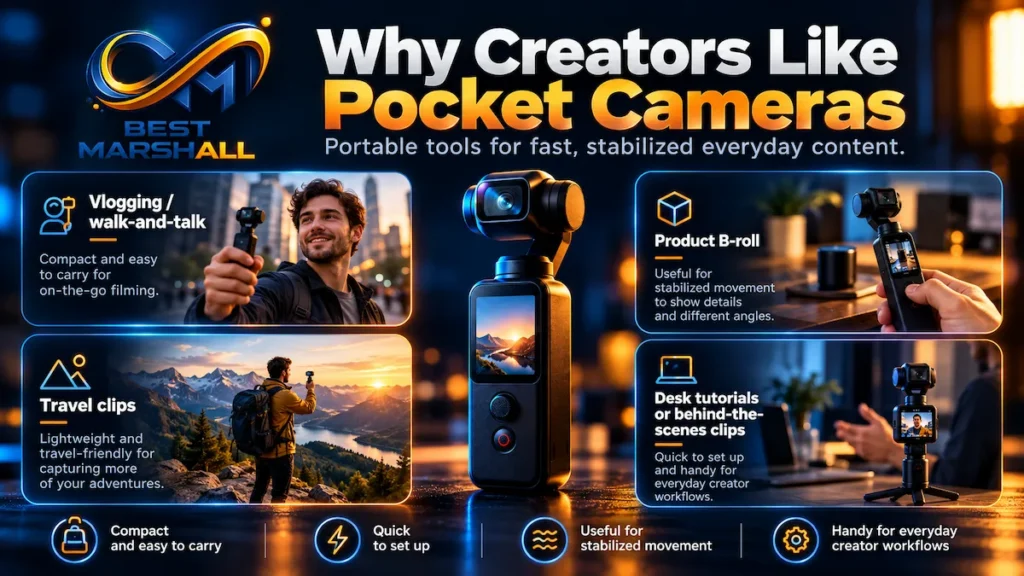
A smartphone can record excellent video, and an action camera may be more durable, but neither offers exactly the same blend of compact size, mechanically stabilized movement, subject tracking, creator-focused controls, and integrated display that made the Pocket 3 popular with vloggers in the first place.
For this review, Best Marshall analyzed DJI’s official specifications and support documentation, current product positioning, competing cameras, independent professional evaluations, and recurring patterns in publicly available customer feedback. Best Marshall did not physically test, own, or use the DJI Osmo Pocket 3.
About the DJI Osmo Pocket 3
The DJI Osmo Pocket 3 is a compact handheld video camera built around a three-axis mechanical gimbal.
Instead of relying primarily on electronic stabilization, as many smartphones and action cameras do, the Pocket 3 physically stabilizes the camera module as the user moves. That allows it to produce smoother walking shots, pans, tracking sequences, and handheld video while remaining small enough to carry in a pocket or small bag.
The camera was designed primarily for:
- vloggers;
- travel creators;
- YouTube creators;
- social-media video;
- behind-the-scenes footage;
- event coverage;
- family videos;
- solo content creation;
- lightweight B-roll capture.
Its central hardware feature is a 1-inch CMOS sensor paired with a 20mm-equivalent f/2.0 lens.
That sensor is considerably larger than the imaging sensors traditionally used in compact action cameras and earlier Pocket models. In practical terms, a larger sensor can help with low-light image quality, dynamic range, background separation, and overall image flexibility.
The Pocket 3 also combines that imaging hardware with:
- three-axis mechanical stabilization;
- a 2-inch rotating OLED touchscreen;
- ActiveTrack 6.0;
- full-pixel phase-detection autofocus;
- 4K recording up to 60 fps in standard modes;
- 4K slow motion up to 120 fps;
- 10-bit D-Log M recording;
- vertical shooting;
- three built-in microphones;
- direct compatibility with selected DJI wireless microphones.
That remains an unusually complete tool set for a camera weighing less than half a pound.
DJI Osmo Pocket 3 Technical Specifications
| Specification | DJI Osmo Pocket 3 |
|---|---|
| Sensor | 1-inch CMOS |
| Lens | 20mm equivalent |
| Aperture | f/2.0 |
| Minimum focus distance | 7.9 in / 0.2 m |
| Standard video | Up to 4K/60 fps |
| Slow motion | 4K/120 fps, 1080p/240 fps |
| Vertical video | Up to 3K/60 fps |
| Maximum video bitrate | 130 Mbps |
| Color options | Standard and 10-bit D-Log M |
| Stabilization | 3-axis mechanical gimbal |
| Autofocus | Full-pixel fast focusing |
| Tracking | ActiveTrack 6.0 |
| Display | 2-inch rotatable touchscreen |
| Display resolution | 556 x 314 |
| Display brightness | 700 nits |
| Built-in microphones | 3 |
| Storage | microSD, up to 1TB |
| Built-in storage | None |
| Wi-Fi | 2.4GHz and 5GHz |
| Bluetooth | Bluetooth 5.2 |
| Battery capacity | 1300 mAh |
| Rated runtime | Up to 166 minutes |
| Charging | USB-C |
| Fast charging | 80% in about 16 minutes |
| Full charging | About 32 minutes |
| Dimensions | 5.5 x 1.7 x 1.3 in |
| Weight | 6.3 oz / 179 g |
| Waterproof | No |
What These Specifications Mean in Practice
The specification that matters most is not 4K by itself.
Most modern smartphones and action cameras can record 4K. What differentiates the Pocket 3 is the combination of a relatively large sensor and mechanical stabilization inside a very small body.
The 1-inch sensor gives the camera more imaging potential than many ultra-compact alternatives, especially when lighting becomes difficult.
The 20mm-equivalent lens is wide enough for handheld vlogging and environmental shots without being as dramatically distorted as some ultrawide action-camera lenses.
The f/2.0 aperture also helps in lower-light situations.
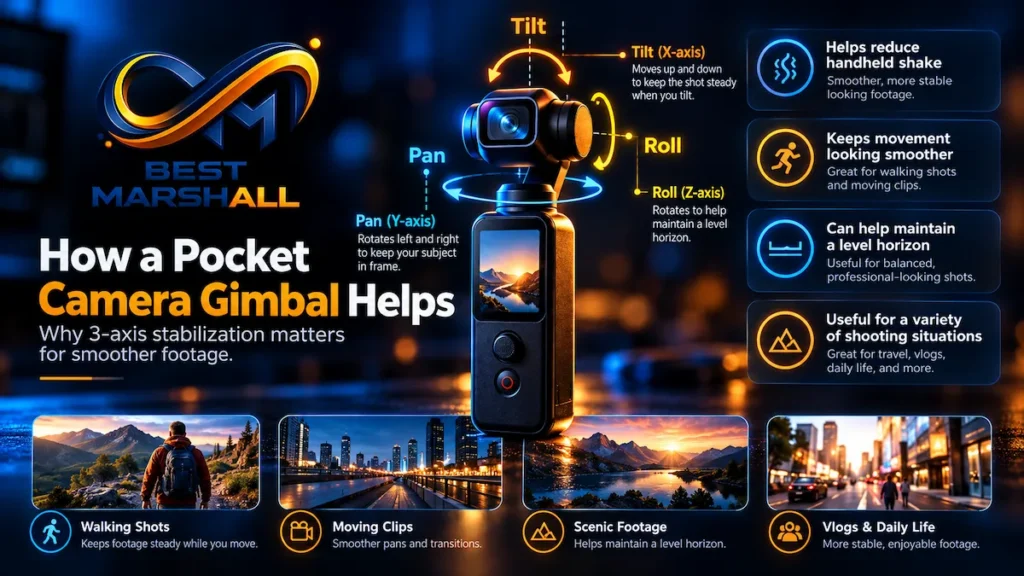
The three-axis gimbal, meanwhile, controls pitch, roll, and pan movement mechanically. That can create a different visual result from electronic stabilization, especially during walking shots and deliberate camera movements.
Real-World Performance and User Experience: Research Analysis
Video Quality
Video quality remains one of the Pocket 3’s strongest reasons to consider it in 2026.
Independent professional evaluations consistently praised the camera’s image quality when it launched, and that assessment has aged relatively well because the underlying hardware remains capable.
The 1-inch sensor gives the Pocket 3 enough imaging headroom to produce detailed 4K footage in good light while maintaining comparatively strong performance as conditions become darker.
Independent testing by Tom’s Guide found that standard low-light footage still showed some visible noise, but the dedicated Low-Light mode produced noticeably brighter results with improved usable dynamic range.
That distinction is important.
The Pocket 3 should not be mistaken for a full-frame low-light camera, but its sensor gives it a meaningful advantage over many smaller-sensor compact cameras.
Stabilization
Mechanical stabilization is still one of the Pocket 3’s defining advantages.
The camera uses a motorized three-axis gimbal rather than relying entirely on digital cropping or electronic image stabilization.
This is particularly useful when:
- walking while filming;
- following another person;
- recording travel footage;
- creating smooth B-roll;
- shooting moving subjects;
- filming yourself while moving.
The gimbal also supports different behavior modes, allowing the camera movement to feel either more locked-in or more responsive depending on the type of shot.
For creators who want smooth movement without carrying a separate camera and gimbal, this remains the Pocket 3’s clearest value proposition.
ActiveTrack 6.0
ActiveTrack 6.0 is particularly useful for solo creators.
The system can identify and follow a subject while the gimbal physically adjusts its orientation to maintain framing.
DJI also includes features such as Face Auto-Detect and Dynamic Framing.
For someone filming alone, this can reduce the need for another person to operate the camera.
A creator can place the Pocket 3 on a tripod, move within the scene, and allow the camera to follow the subject automatically.
That does not replace a camera operator in every situation, but it is extremely practical for:
- tutorials;
- fitness content;
- cooking videos;
- product demonstrations;
- solo travel content;
- talking-head videos with movement.
Autofocus
Full-pixel phase-detection autofocus was a major improvement over earlier Pocket cameras.
The system is designed to maintain focus on moving subjects and includes a Product Showcase mode that prioritizes nearby objects presented to the camera.
That can be useful for product creators who frequently hold an object toward the lens and then move it away again.
The minimum focus distance is approximately 20 centimeters, so it is not a macro camera, but the focusing system is flexible enough for most vlogging and creator scenarios.
Low-Light Performance
The Pocket 3 remains particularly attractive to creators who frequently record indoors or after sunset.
Its dedicated Low-Light mode records up to 4K/30 fps and expands the available sensitivity range compared with standard video modes.
Independent evaluations have generally supported DJI’s positioning here: low-light footage can still contain noise, but the Pocket 3 performs unusually well for a camera of its physical size.
That makes it useful for:
- indoor events;
- restaurants;
- nighttime city footage;
- concerts;
- travel;
- evening vlogs;
- dim home environments.
The limitation is that Low-Light mode sacrifices some frame-rate flexibility, so creators must choose between maximum smoothness and improved low-light optimization depending on the scene.
The Rotating 2-Inch Screen
The touchscreen is another feature that continues to age well.
Rotating the display switches the camera between horizontal and vertical orientations, making it easier to adapt content for traditional video platforms or social media.
The 2-inch panel is still small compared with a phone screen or mirrorless-camera display, but it is large enough for:
- framing;
- exposure adjustments;
- mode selection;
- subject tracking;
- playback;
- changing camera settings.
This means the Pocket 3 can function independently without requiring a smartphone to operate basic camera functions.
Vertical Video
The camera supports native vertical shooting up to 3K/60 fps.
That is useful for TikTok, Instagram Reels, YouTube Shorts, and other vertical-first platforms.
However, vertical resolution tops out below 4K.
This matters more in 2026 than it did at launch because newer creator cameras increasingly offer higher-resolution vertical workflows.
For most social-media publishing, 3K still provides more than enough resolution, but creators who specifically require native 4K vertical capture should be aware of the limitation.
Audio Performance and DJI Microphone Integration
The Pocket 3 includes three built-in microphones and can record stereo audio without requiring external equipment.
For casual use, travel clips, and everyday vlogging, the integrated microphones reduce the amount of gear needed.
Its more important advantage for serious creators is DJI’s wireless-microphone integration.
Current DJI documentation confirms that the Pocket 3 can connect directly to compatible DJI Mic 2 and Mic Mini transmitters, including support for two transmitters.
DJI also now sells Pocket 3 bundles built around newer microphone options.
This creates an unusually compact creator setup: camera, gimbal, touchscreen, tracking system, and wireless microphone can work together without requiring a separate audio receiver mounted to the camera.
Third-party microphones can also be connected through USB-C digital audio or compatible adapters.
For creators who regularly record dialogue, interviews, or presentations, this flexibility is a meaningful advantage over many basic compact cameras.
Battery Life and Charging
DJI rates the internal 1300 mAh battery for up to 166 minutes under its laboratory conditions.
That figure was measured while recording 1080p/24 fps with Wi-Fi and the screen turned off, so buyers should not assume the same runtime when filming 4K, using tracking, keeping the display active, or maintaining wireless connections.
Real-world runtime will vary.
Fast charging is one of the more useful battery-related features.
DJI states that the battery can reach approximately 80% in 16 minutes and 100% in about 32 minutes when using an appropriate high-power USB-C PD charger.
For a creator working between shoots, short charging times can be almost as important as maximum battery capacity.
DJI also sells a Battery Handle with an additional 950 mAh battery. According to DJI’s testing, it can increase operating time by roughly 62%.
Storage and File Handling
One limitation that has become more noticeable in 2026 is the absence of built-in storage.
The Pocket 3 requires a microSD card.
DJI supports cards up to 1TB and maintains a list of recommended compatible models.
For most creators, removable storage is useful because it makes it easy to expand capacity and transfer footage.
However, newer Pocket 4 models add substantial internal storage, which means the Pocket 3 can feel less convenient if a memory card is forgotten or fails.
The camera records using H.264 or HEVC formats and supports a maximum video bitrate of 130 Mbps.
Build Quality, Portability, and Durability
Portability is one of the most consistently praised characteristics of the Pocket 3.
The camera weighs approximately 6.3 ounces and is small enough to carry far more easily than most mirrorless cameras combined with a stabilized lens or separate gimbal.
That portability encourages a different type of filming.
A larger camera may offer better interchangeable lenses or image quality, but it is only useful when someone actually brings it.
The Pocket 3 is designed around being available when a moment occurs.
The trade-off is durability.
The Pocket 3 Is Not Waterproof
DJI explicitly states that the Osmo Pocket 3 is not waterproof.
That separates it from many modern action cameras.
Rain, splashes, beaches, pools, water sports, and harsh outdoor environments therefore require considerably more caution.
The moving gimbal mechanism also makes the camera more mechanically complex than a sealed action camera.
For travel creators, this does not make the Pocket 3 fragile by definition, but it does mean it should be treated more like a compact camera than a rugged action device.
DJI offers optional Care Refresh coverage for accidental situations such as collision and water damage, subject to the plan’s terms.
Benefits That Actually Matter
1. True Mechanical Stabilization in a Pocket-Sized Camera
The Pocket 3’s gimbal remains its defining advantage.
Smartphones can simulate impressive stabilization electronically, but mechanically stabilized movement produces a different shooting experience and gives creators direct control over how the camera follows motion.
2. The 1-Inch Sensor Still Holds Up Well
The sensor remains competitive enough that DJI continued using a 1-inch-class sensor in the next-generation Pocket lineup.
For the Pocket 3, that translates into strong general video quality and better low-light capability than many smaller creator cameras.
3. ActiveTrack Makes Solo Creation Easier
Subject tracking can reduce the need for a second person behind the camera.
For solo creators, this can materially simplify production.
4. Fast Charging Reduces Downtime
A camera that charges quickly is easier to use throughout a full day.
The Pocket 3’s fast-charging capability helps compensate for the limitations of a fixed internal battery.
5. Strong DJI Microphone Integration
Direct wireless-microphone support creates a compact creator ecosystem that is difficult to reproduce as elegantly with many competing cameras.
6. It Is Extremely Portable
The combination of camera, gimbal, display, microphones, and tracking hardware in a 179-gram body remains impressive in 2026.
Cons and Limitations
1. It Is No Longer the Latest Generation
The biggest change in 2026 is obvious: the Pocket 4 now exists.
The newer model adds improvements including:
- newer image processing;
- 4K slow motion up to 240 fps;
- longer rated battery life;
- built-in storage;
- updated autofocus and tracking;
- additional physical controls.
For buyers outside the United States who can purchase the Pocket 4 through official channels, those improvements make the newer camera important to consider.
2. No Built-In Storage
The Pocket 3 requires a microSD card.
A forgotten, full, or failed card can prevent recording.
3. It Is Not Waterproof
This makes it less suitable than an action camera for rain, beaches, water sports, or rugged outdoor use.
4. Vertical Video Tops Out at 3K
For social media this is usually sufficient, but creators specifically seeking native 4K vertical recording may want a newer alternative.
5. Limited Zoom Flexibility
The Pocket 3 uses a fixed 20mm-equivalent lens and digital zoom.
There is no interchangeable lens system and no true optical telephoto capability.
For travel, portraits, events, or distant subjects, that limitation can become noticeable.
DJI Osmo Pocket 3 vs. Osmo Pocket 4
The Pocket 4 is the natural successor.
| Feature | Osmo Pocket 3 | Osmo Pocket 4 |
|---|---|---|
| Sensor | 1-inch CMOS | New 1-inch CMOS |
| Lens | 20mm f/2.0 | 20mm f/2.0 |
| Maximum standard video | 4K/60 fps | 4K/60 fps |
| Maximum slow motion | 4K/120 fps | 4K/240 fps |
| Stabilization | 3-axis gimbal | 3-axis gimbal |
| Display | 2-inch OLED | 2-inch OLED |
| Built-in storage | None | 107GB |
| Rated battery life | Up to 166 min | Up to 240 min |
| Vertical shooting | Yes | Yes |
| U.S. official availability | Yes | No official U.S. availability |
The Pocket 4 is clearly the more capable product on paper.
However, the U.S. market changes the recommendation.
DJI has stated that the Pocket 4 is not officially available in the United States while regulatory authorization remains unresolved.
That means American buyers cannot evaluate the two models as if they were equally supported options.
For U.S. customers who want an officially supported DJI Pocket camera, the Pocket 3 remains far more relevant than its age alone would suggest.
DJI Osmo Pocket 3 vs. Insta360 Luna Pro
The 2026 market also includes newer competitors such as the Insta360 Luna Pro.
The Luna Pro targets the same general concept: a compact stabilized camera built for creators who want better video capability than a smartphone without carrying a conventional camera rig.
It offers newer imaging hardware and longer claimed battery life, which makes it an important alternative for buyers prioritizing the latest technology.
The Pocket 3, however, has advantages that come from maturity:
- a large existing user base;
- established DJI accessories;
- mature ActiveTrack workflows;
- strong integration with DJI microphones;
- extensive tutorials and documentation;
- a proven creator-oriented ecosystem.
For someone choosing strictly on specifications, newer competition deserves attention.
For someone prioritizing a mature workflow and DJI ecosystem compatibility, the Pocket 3 remains compelling.
Who Is the DJI Osmo Pocket 3 For?
Recommended for
Vloggers:
The wide lens, tracking, screen, stabilization, and microphone integration make it particularly well suited to self-recording.
Travel creators:
Its size makes it much easier to carry than a mirrorless camera and gimbal combination.
Solo creators:
ActiveTrack 6.0 can keep a subject framed without a dedicated camera operator.
YouTube beginners:
The Pocket 3 can produce polished video without requiring interchangeable lenses or a complicated stabilization rig.
Event and behind-the-scenes creators:
Its discreet size allows footage to be captured in situations where larger cameras may be intrusive.
U.S. buyers who want a DJI Pocket camera:
Because the Pocket 4 is not officially available in the U.S., the Pocket 3 remains the practical officially supported option.
Not Recommended for
Water-sports creators:
The Pocket 3 is not waterproof.
Creators who need interchangeable lenses:
The fixed 20mm-equivalent lens limits focal-length flexibility.
Users who want the latest Pocket technology:
The Pocket 4 offers significant improvements where it is officially available.
Creators who need true optical zoom:
Digital zoom cannot replace a dedicated telephoto lens.
Anyone who regularly films in harsh environments:
An action camera may be more appropriate.
What Buyers Are Saying
Publicly available customer feedback remains strongly positive around the Pocket 3’s core strengths.
Best Marshall does not use Amazon star ratings or Amazon review-count data in this analysis.
Commonly Praised
Video quality:
Clear, detailed footage is one of the most consistently praised aspects of the Pocket 3.
Portability:
Buyers frequently highlight the ability to carry a stabilized 4K camera in a very small package.
Stabilization:
The three-axis gimbal is regularly cited as one of the product’s biggest practical advantages.
Ease of use:
The rotating display, autofocus, tracking, and automatic shooting modes make the camera approachable even for less experienced users.
Battery performance:
Customer feedback is generally positive about runtime for a device of this size, although actual endurance depends heavily on recording mode and settings.
Common Criticisms
Heat during demanding recording:
Some buyers report that the camera can become noticeably warm during extended or higher-demand recording sessions.
Zoom limitations:
The fixed lens and digital zoom are recurring limitations for users who need tighter framing or distant subjects.
Gimbal movement requires some learning:
Although stabilization is excellent, users may need time to learn how the different gimbal modes respond to intentional pans and movement.
Taken together, buyer feedback largely reinforces the product’s positioning: the Pocket 3 is valued for its image quality, stabilization, and portability, while its main compromises are tied to the limitations of fitting a sophisticated gimbal camera into such a compact body.
Where to Buy the DJI Osmo Pocket 3
The DJI Osmo Pocket 3 is available on Amazon.
Because Best Marshall is currently in its pre-affiliate content-building stage, no affiliate URL or Amazon Associates tracking link is included.
Pricing, bundles, seller availability, and included accessories can change, so verify that the listing corresponds to the DJI Osmo Pocket 3 and carefully check whether you are viewing the standard camera, Creator Combo, or another bundle.
Check Current Price on Amazon
Final Verdict: Is the DJI Osmo Pocket 3 Still Worth It in 2026?
Based on Best Marshall’s research, the DJI Osmo Pocket 3 remains worth considering in 2026—especially for U.S. creators who want a compact, mechanically stabilized camera without moving to a larger mirrorless setup.
Its strongest qualities have aged well: the 1-inch sensor still delivers capable video, the three-axis gimbal remains excellent for moving shots, ActiveTrack 6.0 is highly useful for solo creators, fast charging minimizes downtime, and DJI microphone integration creates a remarkably compact production system.
Its limitations are clearer now than they were at launch.
The Pocket 3 has no built-in storage, is not waterproof, relies on a fixed wide-angle lens, tops out at 3K for vertical shooting, and has now been superseded by the Pocket 4 internationally.
Strengths
- 1-inch CMOS sensor
- Excellent mechanical stabilization
- Strong low-light performance for its size
- ActiveTrack 6.0
- Compact and lightweight design
- Fast charging
- Direct DJI wireless microphone support
- Useful horizontal and vertical workflows
Limitations
- No built-in storage
- Not waterproof
- Fixed lens with digital-only zoom
- Vertical recording limited to 3K
- Newer Pocket 4 exists outside the U.S.
Is It Still Worth It?
Yes — particularly for U.S. vloggers, travelers, and solo creators who want a mature, highly portable camera with excellent stabilization and a proven creator workflow.
Outside the United States, buyers should compare it carefully with the newer Pocket 4 before deciding.
If the DJI Osmo Pocket 3 matches your priorities, check its current price and availability on Amazon before making your final decision.
Frequently Asked Questions About the DJI Osmo Pocket 3
Can the DJI Osmo Pocket 3 replace a smartphone for vlogging?
It can for creators who prioritize stabilized video and subject tracking over an all-purpose device. The Pocket 3 combines a 1-inch sensor, three-axis mechanical gimbal, ActiveTrack 6.0, and dedicated creator controls in a compact body. A smartphone can still record excellent video, but it does not provide exactly the same combination of mechanical stabilization, tracking, and dedicated camera operation.
Is the DJI Osmo Pocket 3 good for filming yourself alone?
Yes. ActiveTrack 6.0, Face Auto-Detect, and the motorized gimbal make the Pocket 3 particularly useful for solo creators. The camera can remain on a tripod while tracking and reframing a moving subject automatically. That makes it well suited to tutorials, fitness videos, product demonstrations, travel content, and other situations where no camera operator is available.
Can DJI wireless microphones connect without a separate receiver?
Yes, with compatible DJI microphones. The Pocket 3 can connect directly to supported DJI Mic 2 and Mic Mini transmitters, including configurations using two transmitters. This can reduce the amount of equipment attached to the camera and create a compact recording setup for dialogue, presentations, interviews, and other creator workflows that benefit from wireless audio.
Can the DJI Osmo Pocket 3 replace an action camera for travel?
Only for some types of travel filming. The Pocket 3 is highly portable and particularly strong for walking footage, vlogging, smooth B-roll, and moving subjects. However, it is not waterproof, and its motorized gimbal makes it less appropriate for rain, water sports, beaches, or harsh environments. Travelers prioritizing ruggedness may be better served by an action camera.
Can the DJI Osmo Pocket 3 replace a mirrorless camera for YouTube?
It can for creators who value portability and simplicity more than lens flexibility. The Pocket 3 combines capable 4K video, mechanical stabilization, autofocus, tracking, and audio integration without requiring a separate gimbal or interchangeable lenses. However, its fixed 20mm-equivalent lens and digital-only zoom make it less versatile for creators who regularly need different focal lengths or true telephoto framing.
Can I use the DJI Osmo Pocket 3 without a smartphone?
Yes. The built-in 2-inch rotating touchscreen lets you frame shots, change camera settings, select recording modes, control subject tracking, and review footage without relying on a smartphone for basic operation. That makes the Pocket 3 a genuinely standalone camera rather than a device that requires a phone to function during normal recording.